

[2026] New CEM exam dumps Use Updated AEE Exam
Verified CEM Dumps Q&As - CEM Test Engine with Correct Answers
NEW QUESTION # 86
The primary advantage of predictive maintenance over preventive maintenance in building energy systems, is that predictive maintenance:
SELECT THE CORRECT ANSWER
- A. Focuses exclusively on energy savings by optimizing system set points
- B. Uses real-time data and analytics to identify potential failures before they occur, minimizing unexpected outages
- C. Schedules routine checks at fixed intervals to reduce downtime
- D. Eliminates the need for regular inspections, reducing operational costs (Note: This option is selected in the image)
Answer: B
NEW QUESTION # 87
According to ISO 50001. when performing internal audits on the energy management system in an organization the internal auditor should do which of the following?
SELECT THE CORRECT ANSWER
- A. Focus on the areas of significant energy use
- B. All of the above
- C. Review the written procedures related to the area under audit
- D. Look for opportunities for energy improvement and to minimize bureaucracy inthe energy management system
- E. Assess actual activities as practiced against what the written procedures state
Answer: B
Explanation:
When conducting internal audits of an Energy Management System (EnMS) in accordance with ISO 50001, auditors are expected to perform several key activities to ensure the system's effectiveness and continual improvement. These activities include:
* Focus on Areas of Significant Energy Use:Auditors should prioritize auditing areas that have substantial energy consumption, as improvements in these areas can lead to significant energy performance enhancements.
* Review Written Procedures Related to the Area Under Audit:A thorough examination of documented procedures ensures that they align with ISO 50001 requirements and organizational practices. This review helps in identifying any discrepancies between documented procedures and actual practices.
* Assess Actual Activities Against Written Procedures:Auditors compare on-ground activities with documented procedures to verify compliance and identify deviations. This assessment ensures that operations are performed as intended and in line with established protocols.
* Look for Opportunities for Energy Improvement and Minimize Bureaucracy:Identifying opportunities for enhancing energy performance is a core objective of the audit.Auditors should also aim to streamline the EnMS by reducing unnecessary complexities, thereby making it more efficient and user-friendly.
By encompassing all these activities, internal auditors ensure a comprehensive evaluation of the EnMS, leading to effective energy management and continual improvement. Therefore, the correct answer is E. All of the above.
NEW QUESTION # 88
An office building is illuminated with T8 fluorescent lamps. Which of the following is the best schedule for group relamping (total replacement of all the T8 fluorescent lamps in the building)?
- A. Every 4 years
- B. When 25% of the lamps have failed
- C. When 20% of the ballasts have failed
- D. When you reach 70% of the rated lamp life
- E. When the building owner changes
Answer: D
NEW QUESTION # 89
What is the main reason for using instrumentation in energy audits?
- A. Support the local economy
- B. Validate utility energy bills
- C. Save energy
- D. Determine energy flows
Answer: D
Explanation:
Instrumentation in energy audits serves multiple functions, but theprimary reasonis to determine energy flows.
* Measuring Energy Flows:
* Instrumentation helpsquantify energy usein different systems, such as electricity, HVAC, and industrial processes.
* It helps identifywhere energy is used, lost, or wasted.
* Supporting Energy Conservation Efforts:
* By measuring energy flows, auditors canidentify inefficienciesand recommend solutions.
* Other Options Analysis:
* Saving energy (A):A result of energy audits, not the main purpose.
* Validating utility bills (C):Important but secondary to understanding energy flows.
* Supporting the local economy (D):Not relevant.
Thus, the correct answer isB. Determine energy flows.
NEW QUESTION # 90
Using the natural gas combustion efficiency tables in your workbook, find the combustion efficiency (based on higher-heating value) of a natural-gas-fired boiler if the excess air level is measured at 31.9% and the stack temperature rise is 187.8°C.
- A. 78%
- B. 76%
- C. 84%
- D. 82%
- E. 80%
Answer: D
NEW QUESTION # 91
What type of heat transfer is reduced by adding insulation to the inside surface of a wall?
- A. Convection
- B. Conduction
- C. Radiation
Answer: B
NEW QUESTION # 92
If the initial design process includes group relamping, how can this reduce the number of lamps required to illuminate a space?
- A. Group relamping improves the room cavity ratio, which means fewer lamps are required to illuminate a space
- B. Group relamping cannot reduce the number of lamps required to illuminate a space
- C. Group relamping reduces factors that contribute to light loss, which means fewer lamps are required to illuminate a space
- D. Group relamping requires using larger Wattage lamps, which means fewer lamps are required to illuminate a space
- E. Group relamping reduces the overall amount of lamp breakages, which means fewer lamps are required to illuminate a space.
Answer: C
NEW QUESTION # 93
How can commissioning reduce the life-cycle cost to owners and operators?
- A. Reduce the cost of change orders during construction
- B. All of the above
- C. Improve the performance of energy systems
- D. Improve the effectiveness of operations and maintenance
- E. Improve the satisfaction of building occupants
Answer: B
NEW QUESTION # 94
Which of the following statements regarding refrigerants is NOT correct?
5ELECT THE CORRECT ANSWER
- A. R-1234yf is a Hydro Fluoro Olefin with zero ozone depleting potential, and little global warming potential
- B. R-11 and R-12 are Chloro Fluoro Carbons with significant ozone depleting potential
- C. R-32 and R-134a are Hydro Fluoro Carbons with zero ozone depleting potential, and significant global warming impact
- D. R-22 is a Hydro Chloro Carbon with significant ozone depleting potential and significant global warming impact
- E. R-407C is a blended Hydro Fluoro Carbon or near Azeotropic mixture, and can be used as a replacement for R-22 in commercial applications
Answer: D
Explanation:
Understanding the environmental impacts of various refrigerants is crucial for energy managers. Let's analyze each statement:en.wikipedia.org A:R-407C is a blended Hydro Fluoro Carbon or near Azeotropic mixture, and can be used as a replacement for R-22 in commercial applications:This statement is correct. R-407C is a blend of HFCs designed to replace R-22 in air conditioning systems.
B:R-11 and R-12 are Chloro Fluoro Carbons with significant ozone depleting potential:This is correct. R-
11 and R-12 are CFCs known for their high ozone depletion potential.
C:R-1234yf is a Hydro Fluoro Olefin with zero ozone depleting potential, and little global warming potential:Correct. R-1234yf is an HFO with negligible ozone depletion and low global warming potential.
D:R-22 is a Hydro Chloro Carbon with significant ozone depleting potential and significant global warming impact:This statement is incorrect.R-22 is a Hydrochlorofluorocarbon (HCFC), not a Hydro Chloro Carbon.While it does have ozone-depleting potential, its global warming potential is considered moderate, not significant.
E:R-32 and R-134a are Hydro Fluoro Carbons with zero ozone depleting potential, and significant global warming impact:This is correct. Both R-32 and R-134a are HFCs with no ozone depletion potential but have considerable global warming potential.
Conclusion:
The incorrect statement is D. R-22 is a Hydro Chloro Carbon with significant ozone depleting potential and significant global warming impact. Therefore, the correct answer is D.
NEW QUESTION # 95
According to the institute of Electrical and Electronic Engineers (IEEE) standard 519. "Recommended Practices and Requirements for Harmonic Control in Electrical Power Systems." the maximum total harmonic distortion (THD) for general low voltage systems less than 600 votts) should be:
SELECT THE CORRECT ANSWER
- A. Less than 10%
- B. Less than 5%
- C. Less than 20%
- D. Greater than 1%
- E. Less than 1%
Answer: B
Explanation:
The Institute of Electrical and Electronics Engineers (IEEE) Standard 519, titled "Recommended Practices and Requirements for Harmonic Control in Electrical Power Systems," sets forth guidelines to maintain the quality of electrical power by limiting harmonic distortions. According to IEEE 519, for general low-voltage systems (defined as systems with a voltage less than 600 volts), the Total Harmonic Distortion (THD) of the voltage waveform should not exceed 5%. This threshold ensures the reliable operation of electrical equipment and minimizes potential issues such as overheating or malfunctioning caused by excessive harmonics.
Therefore, the correct answer is C. Less than 5%.
NEW QUESTION # 96
A compressed air system has a total volume of 247,500 liters. During a 30-minute break in production (air compressor system turned off and no production demand for compressed air), the system pressure drops from
7 bar, gauge (700 kPa, gauge) to 5 bar, gauge (500 kPa, gauge). Calculate the leakage rate in the compressed air system.
- A. 16,500 liters/minute
- B. 8,250 liters/minute
- C. 32,000 liters/minute
- D. 48,250 liters/minute
- E. 22,750 liters/minute
Answer: A
NEW QUESTION # 97
If a boiler cycles on and off too frequently, what control can you adjust to reduce the number of times a boiler cycles on and off?
- A. Reduce the controller differential
- B. Increase the controller set point
- C. Increase the controller differential
Answer: A
NEW QUESTION # 98
A facility uses 250,000 kWh in a 31-day billing period. The peak demand in the billing period is 1,200 kW.
What is the facility partial load factor?
- A. 77%
- B. 28%
- C. 66%
- D. 45%
- E. 33%
Answer: E
Explanation: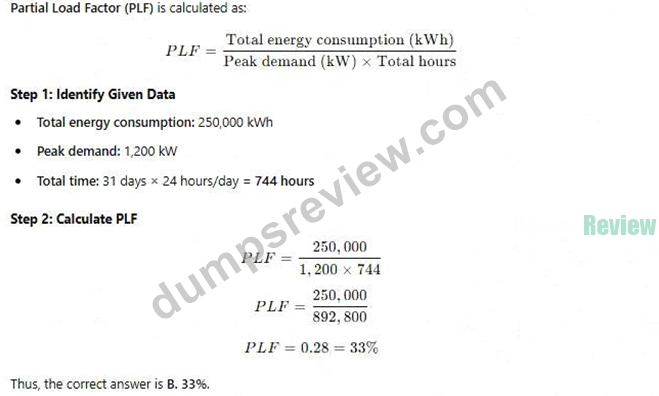
NEW QUESTION # 99
A facility has the thermal cooling load profile shown in the table below. The utility rate traffic has an no-peak time-of-use period that begins at 10:00 a.m ends at 7:00 p.m. What chiller capacity (output) is required for a load-leveling operating strategy?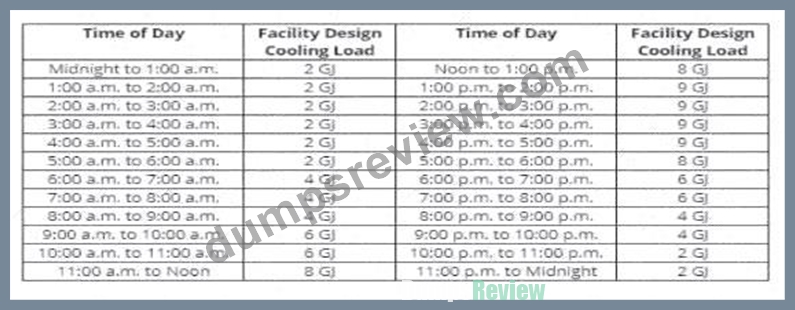
[Question from the previous image, which was about chiller capacity for load leveling, but the table was missing]
- A. 4.0 GJ/h
- B. 5.0 GJ/h
- C. 8.0 GJ/h
- D. 7.0 GJ/h
Answer: B
Explanation:
Comprehensive Detailed Step by Step Explanation with all AEE Energy Manager (CEM) References
* Interpret the load profile (hourly cooling energy):The table gives the facility cooling load in GJ per hour interval (so numerically it's an hourly rate for each hour).
* Compute the total daily cooling energy (sum of 24 hourly loads):
* 12:00 a.m.-6:00 a.m.: 6 hr × 2 = 12 GJ
* 6:00-7:00 a.m.: 4 # 16 GJ
* 7:00-8:00 a.m.: 4 # 20 GJ
* 8:00-9:00 a.m.: 4 # 24 GJ
* 9:00-10:00 a.m.: 6 # 30 GJ
* 10:00-11:00 a.m.: 6 # 36 GJ
* 11:00 a.m.-12:00 p.m.: 8 # 44 GJ
* 12:00-1:00 p.m.: 8 # 52 GJ
* 1:00-2:00 p.m.: 9 # 61 GJ
* 2:00-3:00 p.m.: 9 # 70 GJ
* 3:00-4:00 p.m.: 9 # 79 GJ
* 4:00-5:00 p.m.: 9 # 88 GJ
* 5:00-6:00 p.m.: 8 # 96 GJ
* 6:00-7:00 p.m.: 6 # 102 GJ
* 7:00-8:00 p.m.: 6 # 108 GJ
* 8:00-9:00 p.m.: 4 # 112 GJ
* 9:00-10:00 p.m.: 4 # 116 GJ
* 10:00-11:00 p.m.: 2 # 118 GJ
* 11:00 p.m.-12:00 a.m.: 2 # 120 GJ total per day
So, Total daily cooling energy = 120 GJ.
* Apply the CEM "load-leveling" operating strategy sizing rule:In the AEE CEM Thermal Storage training material, Load Leveling is described as operating the chiller at a constant (or near constant) load for 24 hours per day, and the "load leveling chiller load calculations" are based on Total energy
/ Hours available to operate chillers-for load leveling, that operating window is 24 hours. portal.
aeecenter.org
Therefore:
* Why the "no-peak 10 a.m.-7 p.m." detail doesn't change the load-leveling answer:That time window is typically used when a strategy restricts chiller operation to certain hours (e.g., full load shifting). But load leveling, per the CEM training description, is the strategy where the chiller runs all day at (near) constant load, using storage to absorb the difference between constant production and variable building load
NEW QUESTION # 100
At the end of a performance contract, who owns the equipment installed by the project?
- A. The energy service company
- B. The equipment manufacturer
- C. The bank
- D. The company that paid the contract payments
Answer: D
NEW QUESTION # 101
An energy-saving project saves $30,000 per year. The project life is 10 years and the company minimum annual rate of return (MARR) is 15%. How much can the project cost and still be cost effective?
- A. $198,992
- B. $188,343
- C. $150,570
- D. $201,123
- E. $165,903
Answer: E
NEW QUESTION # 102
......
Pass Your CEM Dumps as PDF Updated on 2026 With 146 Questions: https://quizmaterials.dumpsreview.com/CEM-exam-dumps-review.html
