

Get ISTQB CTAL_TM_001 Dumps Questions Study Exam Guide Jan 25, 2026
CTAL_TM_001 Premium Exam Engine - Download Free PDF Questions
Difficulty in writing the CTAL-TM Exam
As all people know about this fact that CTAL-TM exam is not easy to pass because it requires a lot of efforts and a dependable and latest study material to efficiently pass the exam. Many Candidates have doubts in their mind before writing the Cisco Understanding CTAL-TM certification exam that is a pattern of the test, the types of questions asked in it and the difficulty level of the questions and time required to complete the questions. The best way to pass CTAL-TM exam is to challenge and improve knowledge. Candidates test their learning and identify improvement areas with actual exam format. The best solution is to practice with CTAL-TM Certification Practice Exam because the practice test is one of the most important elements of CTAL-TM exam study strategy in which Candidates can discover their strengths and weaknesses to improve time management skills and to get an idea of the score that they can expect. DumpsReview offers the latest exam questions for the CTAL-TM Exam which can be understood by the candidates deprived of any difficulty. Our 210-250 exam dumps study material is best-suited to busy professionals who don't have much to spend on preparation and want to pass it in a week. Our CTAL-TM practice exam has been duly prepared by the team of experts after an in-depth analysis of Cisco recommended syllabus. We update our material regularly. So, it is intended to keep candidates updated because as and when Cisco will announce any changes in the material; we will update the material right away. After practicing with our CTAL-TM exam dumps Candidate can pass CTAL-TM exam with good grades.
How to study the CTAL-TM Exam
There are two main types of resources for preparation of CTAL-TM certification exams first there are the study guides and books that are detailed and suitable for building knowledge from ground up then there are video tutorials and lectures that can somehow ease the pain of through study and are comparatively less boring for some candidates yet these demand time and concentration from the learner. Smart Candidates who want to build a solid foundation in all exam topics and related technologies usually combine video lectures with study guides to reap the benefits of both but there is one crucial preparation tool as often overlooked by most candidates the practice exams. Practice exams are built to make students comfortable with the real exam environment. Statistics have shown that most students fail not due to that preparation but due to exam anxiety the fear of the unknown. DumpsReview expert team recommends you to prepare some notes on these topics along with it don't forget to practice CTAL-TM exam dumps which had been written by our expert team, Both these will help you a lot to clear this exam with good marks.
NEW QUESTION # 21
What occurs In the retrospective closing?
- A. The strengths and opportunities for improvement in the retrospectives are discussed
- B. Everyone shakes hands
- C. A brainstorming session is held to discuss the solutions to the root causes of the most significant issues
- D. The data collection methods are reviewed
Answer: A
Explanation:
Purpose of Retrospectives:
Retrospectives are team meetings aimed at reflecting on the work process to identify what went well (strengths) and areas that can be improved (opportunities).
This aligns with continuous process improvement practices.
Evaluation of Options:
A (Everyone shakes hands) is trivial and not a core activity.
B (Reviewing data collection methods) may be part of broader discussions but is not the primary focus.
C is correct because it directly reflects retrospective goals.
D (Brainstorming solutions) typically occurs in follow-up sessions, not during the retrospective itself.
Reference and Syllabus Alignment:
Retrospective practices are emphasized in "Improving the Test Process" (TM-1.5.4) in the syllabus.
NEW QUESTION # 22
You have done a comprehensive risk analysis. You have involved the appropriate people in assessing the risks and determining the likelihood and impact of those risks. You have been testing for three months and have been able to mitigate 75% of the high risk items. You have two weeks left in testing and you now do not expect to be able to complete all the items on the high-risk mitigation list, never mind any from the medium or low-risk lists.
What is the most effective action you should take? [3]
- A. Use a random selection algorithm to pick tests from the high, medium, and low risk mitigation lists - thereby ensuring that each risk list has some mitigation.
- B. Concentrate testing in areas that have already found numerous problems.
- C. Retest the highest risk areas to ensure no regressions have occurred.
- D. Present your risk mitigation progress and project status to the project's stakeholders, and request additional time or assistance in re-prioritizing the remaining high-risk items.
Answer: D
Explanation:
When faced with the inability to complete all items on the high-risk mitigation list within the remaining time, the most effective action is to communicate the current progress and challenges to the stakeholders. This allows for a collaborative decision-making process to re-prioritize the remaining high-risk items and potentially secure additional resources or time to address them.
Reference:
The ISTQB Advanced Level Test Manager syllabus emphasizes the importance of continuous monitoring and control of test activities to achieve project objectives, which includes assessing and reporting relevant and timely test status to project stakeholders123. It also highlights the need for test managers to organize and lead risk identification and analysis sessions, and use the results for test planning, monitoring, and control2.
NEW QUESTION # 23
Which of the following would you expect to see in the master test plan? 1 credit
- A. A description of how the test cases are cross-referenced to requirements in the test management tool.
- B. The test approach that will be applied at system integration testing.
- C. A detailed identification of the resources that will carry out structural testing in the first iteration.
- D. A list of the names of the testers who will carry out the performance testing for the final iteration.
Answer: B
Explanation:
Explanation/Reference:
Explanation:
NEW QUESTION # 24
Identify the THREE types of formal peer reviews that can be recognized. 1 credit
- A. Technical review
- B. Management review
- C. Informal review
- D. Inspection
- E. Assessment
- F. Walkthrough
- G. Audit
Answer: A,D,F
Explanation:
Explanation/Reference:
Explanation:
NEW QUESTION # 25
You have investigated different possibilities and selected four of them to present to IT management. Which of the proposals will you most likely give your highest recommendations? 3 credits
- A. Solution from a tool vendor offering to educate two test team members in the use of their easy-to-use test automation capture replay tool over the first 3 month and based on that build the regression test suite. In addition to Vicki, Steve is the only one that has time available to be educated.
- B. Insourcing of test automation based on an offer from a local company ABC that has people who are specialists in system level capture-replay automation tools and they also do regular training courses in test automation methods and tools. They can then work closely with Vicki.
- C. Internal offer from the development department of XYZ to create the regression package using CppUnit as test automation tool. One of the development groups have very good experiences in automating unit tests, and they are willing to do training as well.
- D. Outsourcing of test automation based on an offer from an Asian company, AsiaAutoTest, which has people who are specialists in system level capture-replay automation tools. They also offer training and besides they offer to run and maintain the regression tests in the future.
Answer: B
NEW QUESTION # 26
Which of the following Is a way in which risk analysis drives test analysis?
- A. it drives root cause analysis for any defects found
- B. It determines which tests should be executed first
- C. It guides the selection of test conditions that must be covered by testing
- D. It influences the type of reporting that will be used during execution
Answer: C
Explanation:
Role of Risk Analysis in Test Analysis:
Risk analysis identifies areas with the highest likelihood and impact of failure, enabling the test team to focus on critical functionalities.
It is used to determine test conditions that must be addressed to mitigate risks effectively.
Evaluation of Options:
A is incorrect as determining test execution order happens during test execution, not analysis.
B is correct because selecting test conditions is part of test analysis influenced by risk levels.
C relates to reporting and is unrelated to test analysis.
D pertains to defect management, not test analysis.
Reference and Syllabus Alignment:
This aligns with risk-based testing as described in "Risk Analysis and Risk-Based Testing" (TM-1.3.1).
NEW QUESTION # 27
Which combination matches the four cost of quality categories with a CORRECT example of its category?
- A. a1, b2, c4, d3
Confirmation testing at the system test level
Deploying an emergency fix to production
Designing functional suitability tests
Strengthening recruitment criteria for technical architects - B. a4, b3, c1, d2
- C. a3, b1, c2, d4
- D. a2, b4, c3, d1
Answer: B
Explanation:
The Cost of Quality (CoQ) categories and examples:
* Prevention:a4# Strengthening recruitment criteria prevents defects by improving staff quality
* Appraisal:b3# Designing suitability tests is about verifying quality
* Internal Failure:c1# Confirmation testing after detecting a fault internally
* External Failure:d2# Emergency fix deployment is a result of failures in production This matches:A. a4, b3, c1, d2 Reference:CoQ definitions and examples per ISTQB Advanced Test Manager syllabus.
NEW QUESTION # 28
System testing on your current project is coming to an end and it is time to write the test completion report.
The product is an in-house development to support the Sales & Marketing department. Test design was based on requirements analysis.
Which of the following metrics is MOST likely to be useful to help the business stakeholders decide if testing has met its objectives?
- A. Breakdown by coverage type of the code coverage achieved
- B. Percentage of test cases that have been automated
- C. Breakdown by priority of coverage of requirements
- D. Breakdown by risk level of coverage of product risks
Answer: C
Explanation:
In business-focused testing (requirements-based), stakeholders are most interested in requirement coverage, especially bypriority.
"Metrics... can be used to assess test progress... test coverage of requirements, user stories, acceptance criteria, risks or code."
- ISTQB-CTFL_Syllabus_2018_V3.1, section 5.3.1
Options A and B are more aligned with technical or risk-based strategies. Option C doesn't reflect testing effectiveness.
NEW QUESTION # 29
When Is the metric for the percentage of requirements coverage defined?
- A. Test execution
- B. Test monitoring
- C. Test completion
- D. Test planning
Answer: D
Explanation:
Context Analysis:
Requirements coverage must be defined during test planning to ensure tests align with all requirements from the start of the project.
Evaluation of Options:
A . Test planning:
Correct. Coverage goals are established during planning to define test objectives and scope.
B . Test monitoring:
Incorrect. Monitoring tracks progress but doesn't define coverage.
C . Test execution:
Incorrect. Execution measures coverage but doesn't define it.
D . Test completion:
Incorrect. Completion reviews coverage metrics but doesn't define them.
Syllabus Alignment:
Test planning (TM-1.1.1) includes defining coverage goals and ensuring alignment with requirements.
Reference:
ISTQB Advanced Level Test Management Syllabus (TM-1.1.1)
NEW QUESTION # 30
You have been asked to make a recommendation on deployment readiness on the software your team has been testing. You have the following metrics: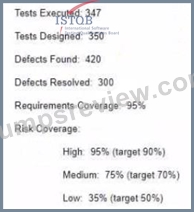
Given this information what is a critical metric you are missing?
- A. Planned vs actual cost of testing
- B. Residual risk
- C. Number of defects outstanding
- D. Number of tests passed
Answer: B
Explanation:
Context Analysis:
Deployment readiness depends on understanding the risk of releasing the software. The metrics provided include execution, design, defect counts, and coverage but do not quantify residual risk, which reflects remaining risks post-testing.
Evaluation of Options:
A . Number of tests passed:
Incorrect. While important, it doesn't directly provide insight into the remaining risk.
B . Number of defects outstanding:
Incorrect. Though critical, it's only one aspect of assessing readiness and doesn't provide the full picture of residual risk.
C . Residual risk:
Correct. Residual risk quantifies untested areas and unresolved issues, vital for decision-making.
D . Planned vs actual cost of testing:
Incorrect. While useful for process evaluation, it's not directly tied to deployment readiness.
Syllabus Alignment:
The syllabus emphasizes risk-based approaches, highlighting residual risk as a critical deployment readiness metric (TM-1.3.4).
Reference:
ISTQB Advanced Level Test Management Syllabus (TM-1.3.4)
NEW QUESTION # 31
You have recently implemented a new defect management process which now includes a defect triage committee whose job is to review all new defects. The process is shown in the following diagram: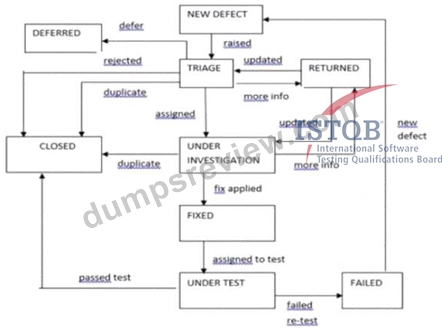
b. The total number of defects rejected as not a problem following investigation by the product author c. The number of defects returned to the defect author, expressed as a percentage of all defects raised d. The total number of defects that failed re-test more than once e. The total number of defects closed by the defect triage committee SELECT ONE OPTION
- A. a and b.
- B. b and d.
- C. c and d.
- D. a and e.
Answer: D
NEW QUESTION # 32
What is the purpose of tracking efficiency metrics for a formal review?
- A. These metrics can be used to determine who participated in the review.
- B. These metrics can be used to determine the quality of the reviewed object.
- C. These metrics can be used to determine the speed with which defects were fixed.
- D. These metrics can be used to determine if the review was a good use of resources.
Answer: D
Explanation:
Efficiency metrics for a formal review are used to measure the cost-effectiveness of the review process, such as the time spent on the review, the number of defects found, and the return on investment1. These metrics can help to evaluate if the review was a good use of resources, such as human effort, money, and tools.
Therefore, option B is the correct answer. Option A is incorrect because efficiency metrics do not track who participated in the review, but rather how they performed. Option C is incorrect because efficiency metrics do not measure the quality of the reviewed object, but rather the quality of the review process. Option D is incorrect because efficiency metrics do not measure the speed with which defects were fixed, but rather the speed with which defects were detected. References: 1: How to manage formal reviews & management audits? Skills,metrics ...
NEW QUESTION # 33
You are working on a project where the business part of the organization works traditionally with defined requirements, but the development team follows an Agile model Neither team plans to change their approach What is the proper name for this type of project approach''
- A. Agile
- B. Hybrid as fit for purpose
- C. Sequential
- D. Hybrid as a transition to Agile
Answer: B
Explanation:
Context Analysis:
The project described has teams using different methodologies (traditional vs. Agile) tailored to their needs.
The "fit for purpose" hybrid approach is explicitly designed to combine methodologies based on team and project requirements.
Evaluation of Options:
A . Sequential:
Incorrect. A sequential approach suggests a traditional waterfall-like model, not a hybrid.
B . Hybrid as a transition to Agile:
Incorrect. This term implies the entire project is transitioning to Agile, which is not the case here.
C . Agile:
Incorrect. Only the development team is Agile; the business team uses a traditional approach.
D . Hybrid as fit for purpose:
Correct. Combines the most effective aspects of both traditional and Agile methodologies to suit the project context.
Syllabus Alignment:
ISTQB defines hybrid models as combinations of methodologies tailored to specific project needs (TM-1.2.4).
Reference:
ISTQB Advanced Level Test Management Syllabus (TM-1.2.4)
NEW QUESTION # 34
Which of the following is likely to occur if reviewers do not have an adequate level of technical knowledge?
[1]
- A. The review is likely to be less efficient.
- B. There will be no impact as long as they have sufficient process knowledge.
- C. There will be no impact as long as they have sufficient business knowledge.
- D. The review will be shorter because any technical aspect can be skipped.
Answer: A
Explanation:
If reviewers do not have an adequate level of technical knowledge, they may not be able to identify and describe anomalies in the product or project under review1. They may also not be able to provide constructive feedback or suggestions for improvement2. This can result in a less efficient review, as the review objectives may not be met, the review process may take longer, or the review outcome may be of lower quality3.
Therefore, option C is the correct answer. Option A is incorrect because having sufficient business knowledge is not enough to perform a technical review, as business knowledge does not cover the technical aspects of the product or project4. Option B is incorrect because having sufficient process knowledge is not enough to perform a technical review, as process knowledge does not cover the technical aspects of the product or project4. Option D is incorrect because skipping any technical aspect can compromise the quality and completeness of the review, and may lead to defects or risks in the product or project5. References: 1: ISTQB Glossary, Reviewer 2: ISTQB Advanced Level Test Manager Syllabus, Section 2.2.2 3: ISTQBAdvanced Level Test Manager Syllabus, Section 2.2.3 4: ISTQB Advanced Level Test Manager Syllabus, Section
2.3.1 5: ISTQB Advanced Level Test Manager Syllabus, Section 2.3.2
NEW QUESTION # 35
You are the Test Manager for a critical system and are using a risk-based approach for this project.
Which of the following would most clearly convey the current status to project stakeholders? [3]
- A. A scatter chart showing test execution status
- B. A Pareto graph showing requirements coverage
- C. A pie chart showing residual risk
- D. A bar graph showing defect density
Answer: C
Explanation:
The most clear way to convey the current status to project stakeholders is to use a pie chart showing residual risk. This is because a risk-based approach focuses on identifying, analyzing, and prioritizing the risks that may affect the quality of the system, and allocating testing resources accordingly. A pie chart can visually represent the proportion of each risk category (such as high, medium, or low) in the overall risk profile, and show how much risk has been reduced or remains after testing. This can help the stakeholders to understand the current level of confidence in the system, and the potential impact of any remaining risks. Reference: Certified Tester Advanced Level Test Manager (CTAL-TM) - ISTQB not-for-profit association, ISTQB Test Manager Certification - ISTQB Exams Worldwide - ISTQB Official Registration, Managing the Test Team - ISTQB not-for-profit association
NEW QUESTION # 36
What is the purpose of the defect management committee?
- A. To ensure the developers fix all defects
- B. To implement strict guidelines for defect report creation
- C. To control the flow of defect reports into the system
- D. To validate defect reports and determine fix plans
Answer: D
Explanation:
Purpose of the Defect Management Committee (DMC):
The DMC evaluates reported defects to confirm their validity, prioritize them, and create plans for resolution.
It ensures effective coordination between testers, developers, and stakeholders.
Evaluation of Options:
A (Controlling defect report flow) is a subset of validation but not the main purpose.
B is correct because it fully captures the committee's role.
C (Implementing strict guidelines) is procedural, not the DMC's core function.
D (Ensuring developers fix all defects) misrepresents the committee's authority.
Reference and Syllabus Alignment:
This aligns with defect lifecycle management as described in "Defect Management" (TM-2.3.1).
NEW QUESTION # 37
You are the Test Manager of a risk-based testing effort. You develop the following graph to show residual risk. Assume that "Risks mitigated" represents passed tests and "Risks not mitigated" represents failed tests and other discovered failures.
Which of the following answers best represents what the graph shows? [3]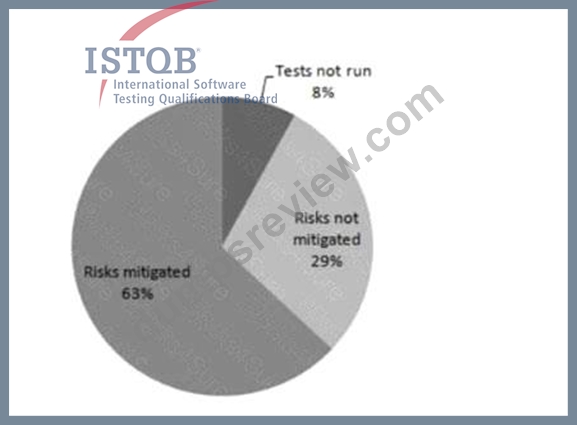
- A. Project is behind schedule based on bug fix rate
- B. Project is at risk due to the number of failed tests
- C. Project is on schedule based on total number of test cases executed
- D. Project is ahead of schedule due to number of risks addressed
Answer: B
Explanation:
The graph indicates that a significant portion of risks, 29%, have not been mitigated, which suggests that these are either failed tests or other discovered failures. This level of unmitigated risk puts the project at risk, as it implies that there are still substantial issues that need to be addressed.
References:The ISTQB Advanced Level Test Manager documents outline the importance of risk-based testing and the interpretation of residual risk graphs. These graphs are used to communicate the current status of risk mitigation efforts in the project, and a high percentage of unmitigated risks is a clear indicator of potential problems1.
NEW QUESTION # 38
Your organisation, a high-street bank, is to embark on a project that delivers a major update to the design of its website and also involves functional and performance improvementchanges to its backend core banking engine. It has traditionally used the V-model software development lifecycle to deliver its projects but has now decided to start migrating to Agile (SCRUM). However, after considering the organisation's current processes and skills plus the importance of the project, senior management has decided to continue to use the V-model approach for the backend core banking engine changes. For the same reasons, they have decided to implement a hybrid model for the website updates. The website updates will begin with a traditional requirement definition phase and will then transition to an Agile (SCRUM) approach for development and testing. The organisation's test policy mandates that all tests must be fully traceable to business requirements to satisfy the regular audits that take place in the banking sector. Which TWO test management activities would be MOST appropriate for the new project?
- A. Ask the business to identify and analyse all product risks, then ensure testing contributes to risk mitigation strategies
- B. Select tools for test automation and continuous integration for the website changes
- C. Ensure there is a continual review of test progress with regular test monitoring and reporting across the whole project
- D. Plan exploratory testing on all of the new website features but use formal scripting for the banking engine
- E. Avoid distinct test phases and ensure testing is continuous and integrated across the whole project
Answer: A,C
Explanation:
This hybrid approach necessitatesrisk-based test planningandcontinuous monitoring, especially with traceability required for audits.
"One of the key responsibilities of the Test Manager is to ensure test activities support risk mitigation and ensure regular monitoring aligned to regulatory compliance." (Source: ISTQB Advanced Level Test Manager Syllabus 2012, Sections 1.5, 2.3.1 and 5.2) Thus,A and Cbest align with the test management goals for this hybrid project.
NEW QUESTION # 39
As part of the test strategy, entry and exit criteria will be defined for each test level. Which is NOT a valid reason for using entry and exit criteria? 1 credit
- A. Entry and exit criteria are a principal way for getting adequate resources.
- B. The expectation is that development testing is not adequate.
- C. Exit criteria are used to decide on when to stop testing.
- D. Using entry and exit criteria will prevent software that is not or poorly tested from going to the next test level.
Answer: A
Explanation:
Explanation/Reference:
Explanation:
NEW QUESTION # 40
Instead of having an independent test team within the company, the company is considering to outsource testing. What are THREE key challenges that are typical for outsourcing? 1 credit
- A. Testing of non-functional requirements
- B. Audit trail from requirements to test cases
- C. Test environment more complex
- D. Possibly different cultures
- E. Define expectation for tasks and deliverables
- F. Applying test automation
- G. Clear channels of communications
Answer: D,E,G
Explanation:
Topic 7, Scenario 7 "Test Estimation"
You have been contracted to manage the acceptance testing of a new computer-based reservation system for a travel agency. You have provided an approximate budget estimate for the testing project based on previous experience with similar sized projects. However, the management of the parent company of the travel agency will not commit to the budget until detailed cost estimates are provided.
The reservation system is being developed by a third party However, detailed specifications of the software are available, as well as an estimate of the total effort that will be spent in developing the software. The software is to be delivered in four increments, and the functionality to be delivered in each increment has already been agreed on.
NEW QUESTION # 41
Which of the following defect statistics will provide input to be used for improvement in the defect reporting process?
- A. Number of defect reports rejected by the developers
- B. Number of defects in a particular area of the code
- C. Number of defect reports re-opened
- D. Number of defects found in a phase later than they were introduced
Answer: A
Explanation:
Purpose of the Questio n :
Identifying metrics to improve the defect reporting process by reducing ambiguities or improving accuracy.
Evaluation of Options:
A . Number of defect reports re-opened:
Incorrect. This reflects issues with defect resolution rather than reporting.
B . Number of defects in a particular area of the code:
Incorrect. This metric pertains to defect clustering, not the reporting process.
C . Number of defect reports rejected by the developers:
Correct. Rejected reports often indicate poor reporting quality (e.g., insufficient details, incorrect categorization), directly highlighting areas for improvement.
D . Number of defects found in a phase later than they were introduced:
Incorrect. This is a measure of defect detection efficiency, not reporting quality.
Syllabus Alignment:
The syllabus stresses the importance of using defect metrics to refine processes, including reporting accuracy (TM-2.3.5).
Reference:
ISTQB Advanced Level Test Management Syllabus (TM-2.3.5)
NEW QUESTION # 42
Which of the following is a key characteristic of a management review?
- A. Used to assess project risks
- B. Conducted by an external group to assess process compliance
- C. Run by a moderator
- D. Used to check consistency of and deviation from the system requirements
Answer: B
Explanation:
A management review, particularly in the context of software testing and quality assurance, often involves an external group or higher-level management team that reviews the processes and procedures to ensure compliance with specified standards or objectives. This can include assessing the effectiveness of current practices, identifying areas for improvement, and ensuring that the project aligns with organizational or industry standards. This type of review is distinct from other forms of reviews like technical reviews or walkthroughs, which might focus more on the technical aspects or consistency of system requirements.
NEW QUESTION # 43
Explain how the above mentioned report may differ from a report that you produce for the project manager, who is a test specialist Select TWO items from the following options that can be used to report to the project manager and would not be included in a report to senior management. 1 credit
- A. Show details on effort spent
- B. List of all outstanding defects with their priority and severity
- C. Show trend analysis
- D. Give product risk status
- E. State recommendations for release
Answer: A,B
NEW QUESTION # 44
You are working on a project where the business part of the organization works traditionally with defined requirements, but the development team follows an Agile model Neither team plans to change their approach What is the proper name for this type of project approach''
- A. Agile
- B. Hybrid as fit for purpose
- C. Sequential
- D. Hybrid as a transition to Agile
Answer: B
Explanation:
* Context Analysis:
* The project described has teams using different methodologies (traditional vs. Agile) tailored to their needs.
* The "fit for purpose" hybrid approach is explicitly designed to combine methodologies based on team and project requirements.
* Evaluation of Options:
* A. Sequential:
* Incorrect. A sequential approach suggests a traditional waterfall-like model, not a hybrid.
* B. Hybrid as a transition to Agile:
* Incorrect. This term implies the entire project is transitioning to Agile, which is not the case here.
* C. Agile:
* Incorrect. Only the development team is Agile; the business team uses a traditional approach.
* D. Hybrid as fit for purpose:
* Correct. Combines the most effective aspects of both traditional and Agile methodologies to suit the project context.
* Syllabus Alignment:
* ISTQB defines hybrid models as combinations of methodologies tailored to specific project needs (TM-1.2.4).
References:
ISTQB Advanced Level Test Management Syllabus (TM-1.2.4)
NEW QUESTION # 45
......
Free CTAL_TM_001 Exam Braindumps ISTQB Pratice Exam: https://quizmaterials.dumpsreview.com/CTAL_TM_001-exam-dumps-review.html
