

Pass Exam With Full Sureness - L4M5 Dumps with 387 Questions
Verified L4M5 dumps Q&As - 100% Pass from DumpsReview
The Chartered Institute of Procurement and Supply (CIPS) L4M5 certification exam is designed to test the knowledge and skills of professionals in the field of commercial negotiation. Commercial Negotiation certification is recognized globally and is highly respected within the procurement and supply chain industry. L4M5 exam covers various topics related to commercial negotiations, including negotiation strategies, legal considerations, and communication skills.
CIPS L4M5 (Commercial Negotiation) Certification Exam is an essential qualification for professionals who are involved in commercial negotiations. Commercial Negotiation certification is designed to help individuals gain the skills and knowledge necessary to succeed in the world of commercial negotiation. L4M5 exam is offered by the Chartered Institute of Procurement and Supply (CIPS), a global organization that promotes excellence in procurement and supply chain management.
NEW QUESTION # 172
Which of the following are most likely to be sources of conflict that can emerge from the process of commercial negotiations? Select TWO that apply.
- A. Differences in conflict management style
- B. Types of purchase
- C. Line of the best fits
- D. Differences in culture
- E. Standard terms and conditions
Answer: A,D
Explanation:
:
There are multiple sources of divergent positions that can arise in situations where money is exchange for goods and services. There are 2 different types of sources. Those that arise from the content or subject matter of the negotiation (what is being negotiated) and those that arise from the process of negotiation (how it is being negotiated).
Sources of divergent positions - the process of negotiation:
Table Description automatically generated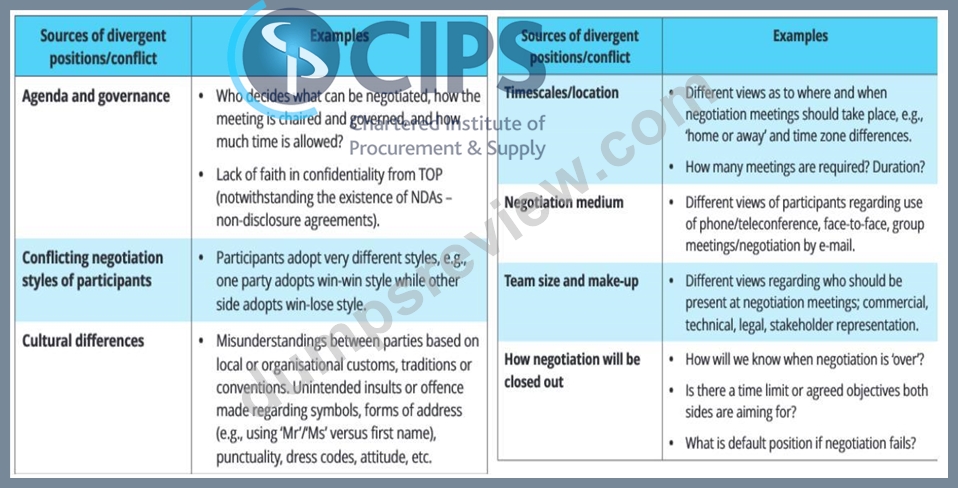
Line of best fits is the line that goes approximately through the middle of the data points with an equal number of data points above and below it. Line of best fits is a method of calculating medium value in statistics.
Standard terms and conditions are basic terms and conditions of business governing transactions that do not have a definitive contract, usually designed to be included in form documents such as orders. While there may be conflicts regarding standard terms and conditions, they are about the content of negotiation, not the process.
Type of purchase: when buying organisation makes an decision to purchase an item, a buyer is faced with three possible scenarios. The item to be bought could be a straight re-buy, a modified re-buy or a new purchase. Decision on type of purchase is purely an internal decision.
NEW QUESTION # 173
Which of the following are tools that help procurement visualise cost breakdowns of products and services purchased from supplier?
1. Spend candlesticks
2. Spend tree
3. Aggregate expenditure model
4. Spend waterfall
- A. 1 and 3 only
- B. 1 and 2 only
- C. 3 and 4 only
- D. 2 and 4 only
Answer: D
Explanation:
:
Understanding where and with whom your supplier spends their money, or understanding the 'cost breakdowns' or 'price build-up' of the goods and services you purchase from the supplier, will help you know where and when they can offer price concessions.
Cost information can be expressed with more impact through graphs that can be created using Excel and PowerPoint or other softwares. There are two commonly used models known as 'spend waterfall' and 'spend tree'. Spend waterfall shows the build-up of costs, while the spend tree shows all the spends that an organisation makes.
There is no graph known as 'spend candlesticks'. Candlestick chart is a style of financial chart used to describe price movements of a security, derivative, or currency.
The aggregate expenditure model is a method of calculating GDP. The aggregate expenditure model focuses on the relationships between production (GDP) and planned spending: GDP = planned spending = consumption + investment + government purchases + net exports.
NEW QUESTION # 174
Different types of relationships impact on commercial negotiations. At a negotiation, which one of the following sources would help to support leverage for the buyer?
- A. Legitimate power
- B. Personality power
- C. Friends power
- D. Powerful colleagues
Answer: A
Explanation:
Legitimate poweris derived from theposition or authorityheld within the organisation. It supports the buyer's ability to influence negotiation outcomes based on formal responsibility, legal rights, or contractual mandates.
"Legitimate power stems from formal roles, authority or responsibility. It enables negotiators to assert terms backed by organisational policy or legal mandate." (L4M5 Commercial Negotiation, 2nd edition, Section 3.1 - Organisational Power Structures in Negotiation)
NEW QUESTION # 175
Sally is negotiating with an oversea supplier on the price and payment period. Her company and the supplying organisation are equal in bargaining power. The supplier says that they are investing in new facilities and machinery so the payment period should not be longer than 30 days. Sally knows that her company often pays the suppliers after 45 days from the delivery, but at the moment the company has positive cash flow and it is able to pay immediately. Which of the following should be Sally's concession plan?
- A. Demand for a discount without any other concessions
- B. Agree with supplier's payment period without any further demand
- C. Contend on the normal payment period
- D. Shorten payment period but ask for a discount
Answer: D
Explanation:
In the scenario, the length of payment period is particularly important to the supplier as they are investing new facilities. Otherwise, the buyer's company has a positive cash flow position and budget is available for a shorter payment terms. So this tradeable (payment period) is important to supplier but it is not a significant problem with the buyer. This tradeable will fall within 'Easy concession to trade' quadrant in the following matrix:
Table Description automatically generated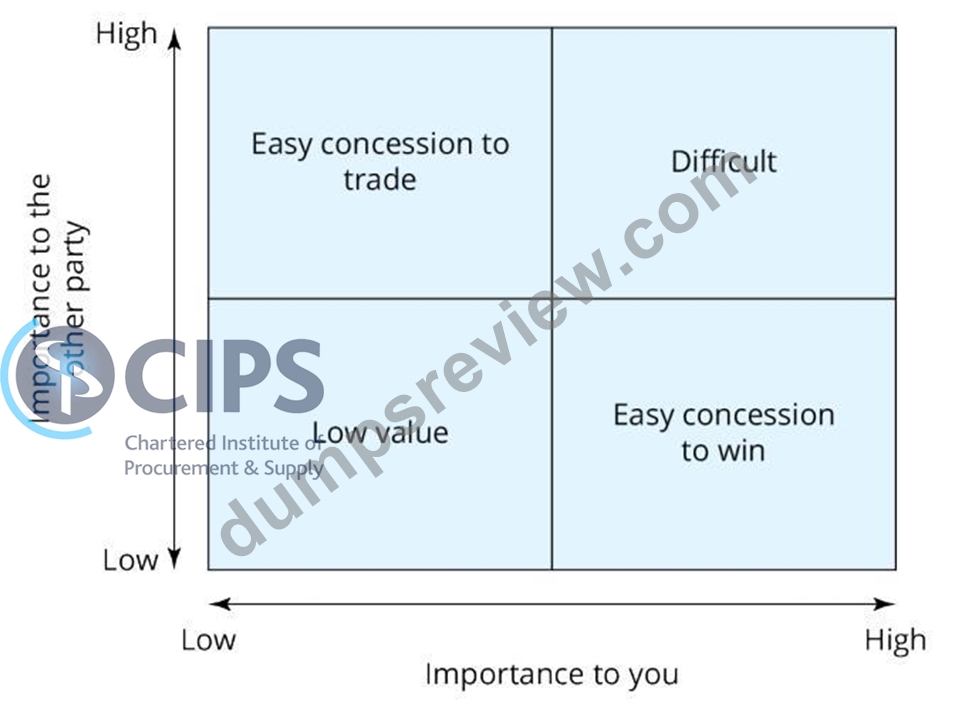
If the tradeable fall within this quadrant, Sally should shorten the payment period in supplier's favour and try to win as many concessions as possible in return. Asking for a discount may be a reasonable trade-off.
LO 2, AC 2.3
NEW QUESTION # 176
When is the best time for buyer to propose the negotiation agenda to potential supplier?
- A. At testing stage
- B. At conclusion stage
- C. At preparation stage
- D. At opening stage
Answer: C
Explanation:
A business negotiation agenda is a formal agreed upon list of goals to be achieved or items to be discussed in a particular order during a meeting or negotiation. Agendas can be formal and obvious, or informal and subtle in negotiations.
The agenda is one of the main structural elements of negotiation, in addition to such questions as site, identification of participants, and elements of timing. Together, they answer the who, what, when, and where questions. As with other aspects of negotiation, the agenda can be used either manipulatively to enhance leverage or to improve the prospects for agreement and the possibilities for mutual gain. In most cases, it will be used both ways, reflecting the nature of negotiation as a "mixed-motive" situation.
Although it can be instrumental to [research] volunteer as a sole source to write the agenda, in most cases it becomes a joint activity to construct a consensual basis for subsequent negotiation. In these situations, agenda- building becomes one of the pre-negotiation activities that set the tone for the relationship (Saunders, 1985).
In other situations, the parties may engage in actual negotiation without a formal or written agenda. When this occurs, the risks and uncertainties may be high but the party who appreciates the importance of the informal agenda has a tremendous advantage.
Whether one plans it or not, during the course of negotiation the parties will discuss a finite set of issues in some sequence and from a particular perceptual framework. Consciousness of the universality and centrality of the agenda is prerequisite to guiding negotiation to a successful conclusion.
Reference:
CIPS study guide page 146-150
Managing the negotiation agenda | SpringerLink
What is Negotiations Agenda - Negotiation Coaching (brightfocusconsult.com)
NEW QUESTION # 177
Which of the following will positively affect reputational strength of an organisation? Select TWO that apply.
- A. Weak internal coordination
- B. Adopting out-of-date technology
- C. High ethical standards
- D. Great gap between reputation and reality
- E. Strong customer focus
Answer: C,E
Explanation:
In a globalised commercial world characterised by dynamic market and multiple companies competing for business, a positive corporate reputation can be an enormous asset. Reputational strength in one organisation might be based on some or all of the following characteristics:
- Quality of products or services
- Low cost/high value for money
- High ethical standards
- Reliability
- Cutting-edge technology
- Strong customer focus
- Engineering excellence
LO 1, AC 1.4
NEW QUESTION # 178
Which of the following are effective approaches when procurement professionals negotiate with monopoly suppliers?
1. Delaying payment with monopoly suppliers as long as possible to increase bargaining power
2. Setting up stronger BATNA
3. Engaging in the negotiation with a distributive approach
4. Eliminating requirements in the specification that prioritises monopoly suppliers
- A. 1 and 4 only
- B. 3 and 4 only
- C. 2 and 3 only
- D. 2 and 4 only
Answer: D
Explanation:
:
In most commercial negotiations with monopolistic organisations, one can expect that in general they will have far greater bargaining power - you will need them more than they need you. There BATNA is stronger in the short run, but over time their power can be challenged effectively.
Ways of dealing with monopoly suppliers include the following:
Making yourself an attractive buyer
Seeking out alternatives / substitutes in a private or public manner
Designing out the requirement that forces you to go to the monopoly suppliers, or seek to make the product, or threaten to make it yourself if feasible Lobbying government or campaigning, as part of an industry or trade body, for a reduction in barriers to entry that support the monopoly
NEW QUESTION # 179
After studying Thomas-Kilmann conflict resolution model and considering different approaches carefully, the procurement team of XYZ Ltd. decides to adopt an avoiding approach to the upcoming negotiation with one of their suppliers.Which of the following will be the objective of XYZ procurement team in this negotiation?
- A. Yielding the supplier's point of view
- B. Postponing the issue
- C. Confronting and trying to find a creative solution immediately
- D. Seeking a quick middle-ground position
Answer: B
Explanation:
Explanation
Avoiding is unassertive and uncooperative. When avoiding, an individual does not immediately pursue his or her own concerns or those of the other person. He or she does not address the conflict. Avoiding might take the form of diplomatically sidestepping an issue, postponing an issue until a better time, or simply withdrawing from a threatening situation.
LO 1, AC 1.1
NEW QUESTION # 180
Procurement team is required to improve leverage with their suppliers through spend consolidation. To check whether there is any opportunity to consolidate spend, which of the following should be priority of procurement team?
- A. Value engineering
- B. Price analysis
- C. Spend analysis
- D. Total cost analysis
Answer: C
Explanation:
Explanation
In order to identify opportunities where you can increase your leverage with supplier, you need to understand your spend. Undertaking spend analysis of your accounts payable (AP) data is an essential first step here.
NEW QUESTION # 181
A procurement manager is preparing for a negotiation with an important supplier. He plans to withhold some crucial information so that his company gains the upper hand in the negotiation. Is this correct when considering using integrative approach to the negotiation?
- A. No, this approach requires honest and open discussion
- B. Yes, the buying organisation must maximise its gain, even at the detriment of the other party
- C. No, holding back information will prompt the supplier gain higher negotiation power
- D. Yes, the supplier must know what buyer wants and how to provide that even when the buyer is silent on these matters
Answer: A
Explanation:
Integrative negotiation is a negotiation strategy in which the involved parties work together to find a solution that satisfies the needs and concerns of each. This process often involves group brainstorming and creative thinking for individuals to suggest different ideas that benefit both parties.
Compromising is often common in integrative negotiation, and both sides may need to give up certain needs to reach a solution. Honesty can also promote successful integrative negotiation because it can lead to a comprehensive understanding of the issue and what each party needs to be satisfied with the result.
Reference:
CIPS study guide page 29-31
Integrative Negotiation: Definition, Tips and Examples | Indeed.com
NEW QUESTION # 182
Lina Rawlins is a senior buyer working for a medical equipment company. Lina is in charge of the company's largest supplier account, Great Barrington Gas (GBG), a medical equipment supplier. Recently GBG's performance has declined, which has led to an increasing number of rejected items. Lina is aware of the seriousness of this, given the nature of the item, and has asked GBG to attend an urgent meeting. In the meeting, Lina asked the GBG representative "Can you tell me exactly what you are doing to ensure quality?" What type of question is Lina asking?
- A. Probing
- B. Leading
- C. Hypothetical
- D. Reflective
Answer: A
Explanation:
Reference: CIPS L4M5 Study Guide, Section 3.2 - The Negotiation Process
NEW QUESTION # 183
Premium pricing strategies used by suppliers are characterised by which of the following? Select TWO that apply.
- A. This strategy is often used when supplier attempts to enter new market
- B. Price is based on cost structures
- C. Typically found in the early part of the product life cycle
- D. Products are charged at a price based on supplier's reputation
- E. Premium price is determined by variable costs only
Answer: C,D
Explanation:
There are several pricing strategies used by suppliers:
Cost-plus pricing - Total variable + Fixed cost + profit
Premium pricing - based on branding. Supplier determines to charge a very high price, notconnected with cost structures, usually based on its reputation and/or the perception that the product/service is of a superior quality. This strategy typically found in the early part of the product life cycle/when demand exceeds supply.
Penetration pricing - Supplier attempts to enter a new market or extend its share in an established one. It is characterised by price reductions to increase volume, followed by steady price increases; may even be loss leading at start (no profit made) Marginal cost pricing - covers only variable cost Market pricing - suppliers prices in line with what the market is willing to pay
NEW QUESTION # 184
Different types of relationships impact on commercial negotiations. At a negotiation, which one of the following sources would help to support leverage for the buyer?
- A. Legitimate power
- B. Personality power
- C. Friends power
- D. Powerful colleagues
Answer: A
NEW QUESTION # 185
A procurement professional is preparing for anegotiation with supplier. She is setting targets for price which her company is seeking to achieve. Which of the following acronyms can help her identify limits before engaging in the negotiation?
- A. PPCA
- B. TIMWOOD
- C. RAQSCI
- D. MIL
Answer: D
Explanation:
MIL criteria indicate 3 limits that negotiator should establish:
M - Must achieve: minimum target/maximum you can concede on this point; the mandatory requirement or fall back position I - Intend to achieve: realistic target you are aiming for on this point L - Like to achieve: stretch target to achieve on this point.
PPCA is purchase cost analysis
TIMWOOD indicates 7 types of waste in Lean principles
The RAQSCI model is a mnemonic summary of a business model used to define and structure business requirements
NEW QUESTION # 186
Which of the following is the true statement?
- A. External stakeholders such as suppliers can largely influence an organisation's procurement negotiations
- B. Internal stakeholder support will be important for both negotiation and contract performance
- C. Commercial negotiation objectives should be driven by just the instincts of procurement
- D. All connected stakeholders have a low level of impact on procurement negotiations
Answer: B
Explanation:
Internal stakeholder support will be important not just at the initial negotiation of the contract, but potentially throughout the life of the contract right through to exit.
As a general rule, connected stakeholders (with the exception of suppliers) have a low level of influence on procurement negotiations.
Suppliers are connected stakeholders who have contractual relationships with the organisation.
Commercial negotiation objective should be driven by thebusiness needs of the organisation, and not just the instinct of procurement.
NEW QUESTION # 187
Which of the following will help to indicate personality preferences in four dimensions?
- A. Mill's RESPECT mnemonic
- B. Thomas-Kilmann Conflict Resolution model
- C. Myers-Briggs Type Indicator
- D. Intelligence quotient
Answer: C
Explanation:
The Myers-Briggs Type Indicator (MBTI) is an introspective self-report questionnaire indicating differing psychological preferences in how people perceive the world and make decisions. MBTI indicates personality preferences in four dimensions.
The Thomas-Kilmann Conflict Mode Instrument (TKI) is a conflict style inventory, which is a tool developed to measure an individual's response to conflict situations.
Mill's RESPECT mnemonic is set out by Harry A. Mills which describes seven steps to agreements An intelligence quotient (IQ) is a total score derived from a set of standardized tests designed to assess human intelligence.
NEW QUESTION # 188
The sourcing manager has decided to adopt an adversarial style of negotiation to take advantage of the buyer' s greater bargaining power over the suppliers. In what other circumstances should an adversarial relationship be used?
- A. In a monopoly market as the supplier will respond by conceding quantity discounts
- B. When the supplier is likely to respond with further concessions to maintain a long-term relationship
- C. In all forms of negotiation as each party is always trying to gain advantage over the other
- D. When the issues concerned are non-negotiable, for example, health and safety commitments
Answer: D
Explanation:
Reference: CIPS L4M5 Study Guide, Section 1.2 - Approaches to Negotiation
NEW QUESTION # 189
......
L4M5 Dumps Full Questions - Exam Study Guide: https://quizmaterials.dumpsreview.com/L4M5-exam-dumps-review.html
