

The ISO-45001-Lead-Auditor PDF Dumps Greatest for the PECB Exam Study Guide!
Read Online ISO-45001-Lead-Auditor Test Practice Test Questions Exam Dumps
PECB ISO-45001-Lead-Auditor Exam Syllabus Topics:
| Topic | Details |
|---|---|
| Topic 1 |
|
| Topic 2 |
|
| Topic 3 |
|
NEW QUESTION # 38
Which two of the following are examples of audit objectives for the audit team?
- A. To improve overall health and safety performance.
- B. To implement any necessary corrective action.
- C. To minimise risk resulting from the audit process.
- D. To reduce instances of injury and ill health.
- E. To complete the audit on time.
Answer: C,E
Explanation:
Audit objectives for the audit team focus on ensuring the audit process is executed effectively, efficiently, and without causing undue disruption to the organization being audited. ISO 19011:2018 provides guidance on setting audit objectives.
Analysis of Options:
A . To reduce instances of injury and ill health:
Incorrect. This is an objective of the OH&S management system, not of the audit itself.
B . To minimise risk resulting from the audit process:
Correct. ISO 19011 emphasizes managing risks to the auditee and the audit process during audits (Clause 5.4).
C . To improve overall health and safety performance:
Incorrect. Improving health and safety performance is an outcome of the OH&S management system, not the audit team's objective.
D . To complete the audit on time:
Correct. Ensuring timely completion of the audit aligns with effective audit management.
E . To implement any necessary corrective action:
Incorrect. Implementing corrective actions is the auditee's responsibility, not the audit team's.
Reference:
ISO 45001:2018:
Clause 5.4: Worker consultation and participation.
Clause 6.2: OH&S objectives and planning.
Clause 8.1.2: Hierarchy of controls and worker involvement.
ISO 19011:2018: Guidelines for auditing management systems.
NEW QUESTION # 39
Wash-it-up is an organization that provides window cleaning services for the industrial sector. It has been certified t ISO 45001 for some time and has appointed a new OHS Manager. The audit plan during a surveillance audit includes the improvement actions and the auditor asks to see the most recent management review meeting minutes.
surveillance audit includes the Improvement actions and the auditor asks to see the most recent management review meeting minutes.
Which six of the statements would represent output audit evidence for the management review?
- A. Allocation of a bigger budget for the OHS department
- B. Decagons related to continual improvement opportunities
- C. Improvements In the OHSMS
- D. Procurement of new safety harnesses for workers
- E. Worker feedback of positive and negative comments
- F. Report showing the trend of an increase In safety incidents
- G. Minutes of previous management reviews
- H. Plan to priorities health and safety issues as a business strategy
- I. Updates to the risk register
- J. Opportunities to integrate the OHS management system with other business processes
Answer: A,B,C,H,I,J
Explanation:
Comprehensive Detailed Explanation along with All ISO 45001 Audit References Clause 9.3 of ISO 45001:2018 outlines the requirements for management reviews. These reviews must evaluate the performance of the OHSMS and identify opportunities for improvement. Outputs of management reviews typically include decisions and actions that align with strategic and operational priorities.
Analysis of Options:
* A. Decisions related to continual improvement opportunities:This is a valid output, as continual improvement is a key objective of management reviews under Clause 10.3.
* B. Allocation of a bigger budget for the OHS department:Resource allocation is a common output of management reviews to address identified needs.
* C. Improvements in the OHSMS:Improvements reflect the organization's commitment to enhancing safety performance.
* D. Minutes of previous management reviews:While minutes provide context, they are not an output of the current management review.
* E. Opportunities to integrate the OHS management system with other business processes:
Integration opportunities are valid outputs, as they enhance the system's effectiveness.
* F. Plan to prioritize health and safety issues as a business strategy:Strategic alignment of health and safety with business objectives is an expected output.
* G. Procurement of new safety harnesses for workers:This is an operational action, not a direct output of the management review process.
* H. Report showing the trend of an increase in safety incidents:This is an input to the management review, not an output.
* I. Updates to the risk register:Risk register updates reflect changes in identified hazards and risks, making this a valid output.
* J. Worker feedback of positive and negative comments:Worker feedback is an input to the management review, not an output.
ISO References:
* Clause 9.3: Management review inputs and outputs.
* Clause 10.3: Continual improvement actions.
NEW QUESTION # 40
Select the two options which describe a disadvantage of using a checklist.
- A. Not varying from the checklist when necessary
- B. Ensuring relevant audit trails are followed
- C. Assisting with starting an interview
- D. Noting down evidence details
- E. Using the same checklist for every audit without review
- F. Helping with sampling of evidence
Answer: A,D
NEW QUESTION # 41
You have been assigned by the audit team leader to evaluate the process of complying with application legislation.
Which three of the following statements about the evaluation of compliance are true?
- A. The organisation is required to establish a process for evaluating compliance
- B. Every member of an audit team must have a detailed understanding of the legal requirements for the sector and type of organisation they are auditing.
- C. The organization must evaluate its compliance status at least once a year
- D. The organisation is required to evaluate its compliance status with OH&S legal and other requirements
- E. 'Other requirements' include requirements that the organisation has chosen to comply with.
- F. The organisation cannot outsource its process for evaluating compliance.
- G. A management review is required in all instances where one or more legal requirements are not being met.
- H. If the organisation is falling to address a legal requirement relating to another discipline e.g. Environmental management, this cannot be raised In the audit.
Answer: A,D,E
Explanation:
Comprehensive Detailed Explanation along with All ISO 45001 Audit Reference Clause 9.1.2 of ISO 45001:2018 outlines the need for organizations to evaluate compliance with applicable legal and other requirements as part of their OH&S management system.
Analysis of Options:
A :The organization must evaluate its compliance status at least once a year:
The standard does not prescribe a specific frequency but states that evaluations must be conducted at planned intervals.
B :'Other requirements' include requirements that the organization has chosen to comply with:
Correct. Other requirements may include voluntary standards, industry codes, or contractual obligations.
C :A management review is required in all instances where one or more legal requirements are not being met:
This is not true. Management reviews address compliance but are not mandated for every noncompliance.
D :Every member of an audit team must have a detailed understanding of the legal requirements for the sector and type of organization they are auditing:
Not true. Auditors must have general competency but can rely on subject-matter experts for legal specifics.
E :If the organization is failing to address a legal requirement relating to another discipline (e.g., Environmental management), this cannot be raised in the audit:
Not true. If the legal noncompliance impacts OH&S, it can be raised.
F :The organization cannot outsource its process for evaluating compliance:
The organization can outsource evaluation but retains accountability.
G:The organization is required to establish a process for evaluating compliance:
Correct. Clause 9.1.2 requires a process for compliance evaluation.
H :The organization is required to evaluate its compliance status with OH&S legal and other requirements:
Correct. Clause 9.1.2 explicitly states this requirement.
ISO Reference:
Clause 9.1.2: Evaluation of compliance.
Clause 7.5: Documented information requirements
NEW QUESTION # 42
You are auditing clause 4.1 (Context of the organisation) with a member of the organisation's top management. You ask them for examples of external issues the OHSMS is currently facing.
Which three of their responses would you accept as valid examples of such issues?
- A. Our top management are demanding monthly health and safety performance reports ever since the fatal accident in warehouse C last year.
- B. New health and safety legislation was implemented in our sector last month and we are all struggling to work out how best to comply with the new regulations.
- C. We have to use outdated safety equipment as replacing it would require expensive retraining of the workers.
- D. I accept our health and safety procedures have not been revised for 12 months now. We just keep pushing the review further and further down the 'to do' list.
- E. The training department have decided to use their budget on customer service training in preference to health and safety training.
- F. The Government has just launched an initiative to provide research and development grants to organisations like ours.
- G. The worker OH&S suggestion scheme has been temporarily suspended after some inappropriate comments were made by staff.
- H. We are struggling to appoint an OH&S manager as the salary we can offer is not competitive in today's market.
Answer: B,F,H
NEW QUESTION # 43
When calculating an ISO 45001 third party initial audit duration, which two of the following statements are false?
- A. Incorporate the time taken to travel to/from the audit location
- B. Consider the number of sites to be sampled
- C. Include outsourced processes
- D. Consider the number of functions related to OHS management
- E. Think about the complexity of the organization's business
- F. Include the time allocated for lunch breaks
Answer: A,F
Explanation:
Comprehensive Detailed Explanation along with All ISO 45001 Audit Reference Analysis of Each Option:
A . Consider the number of functions related to OHS management.
True.
The number of functions related to OHS management directly impacts the audit duration. More functions require additional time for the auditor to review documentation, processes, and implementation across those areas.
Reference: IAF MD 5:2020, Clause 2.3.1 (factors affecting audit time).
B . Consider the number of sites to be sampled.
True.
For multi-site organizations, the number of sites to be sampled is critical in calculating audit duration. Sampling requirements are determined using guidelines such as IAF MD 1:2022 and depend on the complexity, size, and risks associated with each site.
Reference: IAF MD 1:2022, Clause 4.2.
C . Include outsourced processes.
True.
Outsourced processes that affect the OHS management system must be evaluated as part of the audit. This includes reviewing the organization's control over such processes. Auditing these aspects impacts the audit duration.
Reference: ISO 45001:2018, Clause 8.1.4 and IAF MD 5:2020, Clause 2.3.1.
D . Include the time allocated for lunch breaks.
False.
Lunch breaks are not considered part of the audit duration as they do not contribute to the assessment of the management system. Audit time calculations exclude non-working hours, including breaks.
Reference: IAF MD 5:2020, Clause 2.5.
E . Incorporate the time taken to travel to/from the audit location.
False.
Travel time is excluded when calculating the audit duration. While travel logistics are considered in audit planning, they do not count towards the total audit time.
Reference: IAF MD 5:2020, Clause 2.5.
F . Think about the complexity of the organization's business.
True.
The complexity of the organization's business, including the nature of hazards, risks, and legal obligations, significantly affects the audit duration. More complex operations typically require longer audit times.
Reference: IAF MD 5:2020, Clause 2.3.1.
Key ISO and IAF Reference:
ISO 45001:2018: Clause 9.2.2 (Audit Program).
IAF MD 5:2020: "Determination of Audit Time of Quality and Environmental Management Systems." IAF MD 1:2022: "Audit and Certification of Multiple Sites Based on Sampling."
NEW QUESTION # 44
You identify that the OSHMS manager conducts a safety inspection of the building each day before the museum opens to the public. You review your latest report and note that there seems to be some confusion between what constitutes a hazard and what constitutes a risk.
Which three of the following observations has the OHSMS manager correctly rated?
- A. There is a water leak next to the electric heater in the admissions area (Danger)
- B. Conference room emergency sign directs people to an exit that is no longer available for use (Hazard)
- C. The fire extinguishers in the Natural World area have not been serviced in the last five years [Risk)
- D. The carpet on the main staircase is peeling off (Risk)
- E. The emergency light In the gift shop did not work when checked (Risk)
- F. There Is a high possibility of unfit food being sold due to the failure of the oven temperature indicator In the visitors' restaurant (Hazard)
- G. The head of the dinosaur suspended over the main hall has become detached from the rest of the skeleton (Risk)
- H. The non-slip mats have been removed from the restaurant (Risk)
Answer: C,D,E
Explanation:
Comprehensive Detailed Explanation along with All ISO 45001 Audit References
* Hazard: A potential source of harm or adverse health effects.
* Risk: The likelihood of harm occurring as a result of the hazard.
* Danger: An immediate threat that requires urgent action.
Analysis of Options:
* A. Conference room emergency sign directs people to an exit that is no longer available for use (Hazard):Correctly identified as a hazard since it poses a potential risk during emergencies.
* B. The carpet on the main staircase is peeling off (Risk):This is a hazard, not a risk, as it represents a source of potential harm.
* C. The emergency light in the gift shop did not work when checked (Risk):This is a hazard because it is a condition that could lead to a risk during emergencies.
* D. The fire extinguishers in the Natural World area have not been serviced in the last five years (Risk):Correctly identified as a risk because the likelihood of fire-related harm increases without proper servicing.
* E. The head of the dinosaur suspended over the main hall has become detached from the rest of the skeleton (Risk):This is a hazard, not a risk, as it represents a potential source of harm.
* F. The non-slip mats have been removed from the restaurant (Risk):This is a hazard, not a risk.
* G. There is a high possibility of unfit food being sold due to the failure of the oven temperature indicator in the visitors' restaurant (Hazard):This is a risk because it specifies the likelihood of harm occurring (selling unfit food).
* H. There is a water leak next to the electric heater in the admissions area (Danger):Correctly identified as a danger because it represents an immediate and critical threat.
ISO References:
* Clause 6.1.2: Hazard identification and assessment of risks and opportunities.
NEW QUESTION # 45
An auditor of a manufacturer of plastic packaging products for the food industry found a nonconformity in an internal audit report raised against section 10.2 of ISO 45001 in Report IA202. The nonconformity (NC3) stated: "The level of reported health and safety incidents has increased by 9.7% over the last 12 months. This included an increase in reported accidents." Against this background, the third-party audit team found more than twenty minor nonconformities during the audit, which they agreed should be combined into one major nonconformity against clause 4.4 of ISO 45001. "The organisation has failed to demonstrate that it is maintaining and continually improving a health and safety management system." Select two options which would represent acceptable corrective actions for the nonconformity.
- A. External consultants were appointed to conduct a gap analysis of the OHSMS and report on the gaps found.
- B. OH&S champions were appointed in each department to report near misses and incidents in the OHSMS.
- C. Top Management developed and is leading a programme to promote an effective culture of support for the OHSMS.
- D. Top management initiated a comprehensive review of the internal and external issues to decide on actions that could lead to improving the performance of the OHSMS.
- E. Union representatives of the workers were invited to attend the OH&S management meetings.
- F. Staff from departments with nonconformities were given regular OH&S safety training sessions during their daily toolbox talks.
Answer: C,D
Explanation:
Clause 4.4 of ISO 45001 requires organizations to establish, implement, maintain, and continually improve an OH&S management system. The corrective actions must address systemic issues, involve leadership commitment, and aim to foster a strong safety culture.
Analysis of Options:
A . Top management initiated a comprehensive review of internal and external issues:
Correct. A review of internal and external issues aligns with Clause 4.1 and demonstrates leadership commitment.
B . Union representatives were invited to attend OH&S management meetings:
Incorrect. While participation is valuable, it is not a systemic corrective action.
C . Top management developed and is leading a programme to promote an effective culture of support:
Correct. Promoting a safety culture is a proactive measure and aligns with Clause 5.1 (Leadership).
D . Staff from departments with nonconformities received regular safety training during toolbox talks:
Incorrect. While training addresses specific gaps, it does not address systemic issues.
E . External consultants conducted a gap analysis of the OHSMS:
Incorrect. While helpful, this action does not demonstrate leadership or address systemic improvement.
F . OH&S champions were appointed in each department to report near misses and incidents:
Incorrect. This is a good practice but does not directly address Clause 4.4's requirement for systemic improvement.
ISO Reference:
Clause 4.4: Maintaining and improving the OH&S management system.
Clause 5.1: Leadership and commitment.
Clause 10.3: Continual improvement.
NEW QUESTION # 46
You will lead a second-party audit of an organization that manufactures car batteries. When you are checking the audit plan with the auditee's Safety Manager, she asks you to reduce the production line audit from two hours to one hour and to extend the audit to the warehouse from two hours to three hours. She argues that in the last four internal audits, she did not raise any nonconformities in Production while more than 10 were raised in the warehouse.
Which of the following would be your best answer?
- A. OK. I will change the plan. If necessary, I will use the lunchtime to stay longer in the warehouse.
- B. OK. I will reduce the time in Production to one hour and will review with you (the Safety Manager) the corrective action process in detail during the second hour.
- C. I will not change the plan, but I will consider your comments during the audit.
- D. OK. I will change the plan accordingly.
Answer: C
NEW QUESTION # 47
ISO 45001 requires the organisation to retain OHSMS documented information. From the following list of documented information, which four examples must be retained by the organisation?
- A. Risks and opportunities
- B. Workers' current level of competency
- C. Results of management review
- D. Assigned responsibilities and authorities
- E. The relevant requirements of workers
- F. OH&$ Policy
- G. Results of compliance evaluation
- H. Effectiveness of corrective actions
Answer: C,F,G,H
Explanation:
Analysis of Options:
* A. Results of management review:Correct. Clause 9.3 requires retention of management review results as documented information.
* B. Risks and opportunities:Incorrect. Risks and opportunities must be considered and managed, but retaining this as documented information is not mandatory.
* C. Results of compliance evaluation:Correct. Clause 9.1.2 requires retention of compliance evaluation results.
* D. Workers' current level of competency:Incorrect. Competency must be ensured, but retaining specific competency records is not explicitly required.
* E. Assigned responsibilities and authorities:Incorrect. These must be defined and communicated but are not required to be retained as documented information.
* F. The relevant requirements of workers:Incorrect. Relevant worker requirements must be considered but not retained as documented information.
* G. Effectiveness of corrective actions:Correct. Clause 10.2 requires retention of evidence of corrective actions taken.
* H. OH&S Policy:Correct. Clause 5.2 requires the OH&S policy to be maintained as documented information.
ISO References:
* Clause 5.2: OH&S policy.
* Clause 9.1.2: Compliance evaluation.
* Clause 9.3: Management review.
* Clause 10.2: Corrective actions.
NEW QUESTION # 48
Wash-it-up is an organization that provides window cleaning services for the industrial sector. It has been certified t ISO 45001 for some time and has appointed a new OHS Manager. The audit plan during a surveillance audit includes the improvement actions and the auditor asks to see the most recent management review meeting minutes.
surveillance audit includes the Improvement actions and the auditor asks to see the most recent management review meeting minutes.
Which six of the statements would represent output audit evidence for the management review?
- A. Allocation of a bigger budget for the OHS department
- B. Decagons related to continual improvement opportunities
- C. Improvements In the OHSMS
- D. Procurement of new safety harnesses for workers
- E. Worker feedback of positive and negative comments
- F. Report showing the trend of an increase In safety incidents
- G. Minutes of previous management reviews
- H. Plan to priorities health and safety issues as a business strategy
- I. Updates to the risk register
- J. Opportunities to integrate the OHS management system with other business processes
Answer: A,B,C,H,I,J
Explanation:
Comprehensive Detailed Explanation along with All ISO 45001 Audit Reference Clause 9.3 of ISO 45001:2018 outlines the requirements for management reviews. These reviews must evaluate the performance of the OHSMS and identify opportunities for improvement. Outputs of management reviews typically include decisions and actions that align with strategic and operational priorities.
Analysis of Options:
A . Decisions related to continual improvement opportunities:
This is a valid output, as continual improvement is a key objective of management reviews under Clause 10.3.
B . Allocation of a bigger budget for the OHS department:
Resource allocation is a common output of management reviews to address identified needs.
C . Improvements in the OHSMS:
Improvements reflect the organization's commitment to enhancing safety performance.
D . Minutes of previous management reviews:
While minutes provide context, they are not an output of the current management review.
E . Opportunities to integrate the OHS management system with other business processes:
Integration opportunities are valid outputs, as they enhance the system's effectiveness.
F . Plan to prioritize health and safety issues as a business strategy:
Strategic alignment of health and safety with business objectives is an expected output.
G . Procurement of new safety harnesses for workers:
This is an operational action, not a direct output of the management review process.
H . Report showing the trend of an increase in safety incidents:
This is an input to the management review, not an output.
I . Updates to the risk register:
Risk register updates reflect changes in identified hazards and risks, making this a valid output.
J . Worker feedback of positive and negative comments:
Worker feedback is an input to the management review, not an output.
ISO Reference:
Clause 9.3: Management review inputs and outputs.
Clause 10.3: Continual improvement actions.
NEW QUESTION # 49
Whistlekleen is a national dry cleaning and laundry organization with 50 shops. You are conducting an OHSMS surveillance audit of the head office and are sampling health and safety performance monitoring.
You find that 80 per cent of incident originate from five shops in the same region. Most of these relate to staff and customer feeling unwell due to breathing in the pungent atmosphere. Some required to be hospitalized.
The OHS Manager tells you that these are the oldest shops in the organization. The cleaning equipment emits Volatile Organic Compounds (VOCs) and needs replacing but the organisation cannot afford it at the moment.
You raise the following nonconformity against clause 10.2 of ISO 45001.
''The organization failed to act after incidents in the five old shops involving the release of VOCs from laundry operations, which resulted in injury in some instances. The equipment used was not capable of consistently operating to the required level of safety'' Select one of the options which would constitute the most effective corrective action for the nonconformity.
- A. Reassess the OH&S risks associated with the laundry process in the five old shops.
- B. Evaluate and update the Personal protective equipment (PPE) requirements for employees working with strong chemicals such as face masks and gloves.
- C. Display on emergency phone number in a prominent place to ensure that injured workers and shoppers
- D. Review the current safety procedures related to handling and use of chemicals In the laundry process to ensure their effectiveness.
Answer: A
Explanation:
Comprehensive Detailed Explanation along with All ISO 45001 Audit References Clause 10.2 of ISO 45001 pertains to Nonconformity and Corrective Action. Organizations are required to evaluate incidents, investigate their causes, and implement effective corrective actions to prevent recurrence.
* Issue Identified:The incidents in the five old shops are related to VOC emissions from outdated equipment, leading to staff and customer health concerns. This indicates inadequate risk management and failure to act on known safety issues.
* Analysis of Options:
* A. Display an emergency phone number.This is a reactive approach and does not address the root cause of the issue, i.e., VOC emissions. It also does not align with ISO 45001's emphasis on preventive measures.
* B. Evaluate and update the PPE requirements.While PPE is important, relying solely on PPE without addressing the root cause (emission of VOCs) is insufficient. PPE is considered the last line of defense under the hierarchy of controls.
* C. Reassess the OH&S risks associated with the laundry process in the five old shops.This option aligns with ISO 45001, Clause 8.1.2, and Clause 10.2, as it emphasizes reassessing risks and taking steps to mitigate them. A thorough risk assessment could lead to interim measures such as process improvements or administrative controls until the equipment is replaced.
* D. Review the current safety procedures.While reviewing safety procedures is useful, it does not address the specific nonconformity related to the equipment's inability to operate safely.
* Best Action:Reassessing the risks in the five shops (Option C) ensures a comprehensive review of the hazards posed by outdated equipment, leading to appropriate preventive and corrective actions.
ISO References:
* Clause 10.2: Requires identifying and addressing nonconformities to prevent recurrence.
* Clause 8.1.2: Emphasizes the hierarchy of controls and risk assessment as a foundation for mitigating hazards.
NEW QUESTION # 50
You have been assigned by the audit team leader to evaluate the process of complying with application legislation.
Which three of the following statements about the evaluation of compliance are true?
- A. If the organisation is falling to address a legal requirement relating to another discipline e.g.
Environmental management, this cannot be raised In the audit. - B. The organisation is required to establish a process for evaluating compliance
- C. Every member of an audit team must have a detailed understanding of the legal requirements for the sector and type of organisation they are auditing.
- D. The organization must evaluate its compliance status at least once a year
- E. The organisation is required to evaluate its compliance status with OH&S legal and other requirements
- F. 'Other requirements' include requirements that the organisation has chosen to comply with.
- G. The organisation cannot outsource its process for evaluating compliance.
- H. A management review is required in all instances where one or more legal requirements are not being met.
Answer: B,E,F
Explanation:
Comprehensive Detailed Explanation along with All ISO 45001 Audit References Clause 9.1.2 of ISO 45001:2018 outlines the need for organizations to evaluate compliance with applicable legal and other requirements as part of their OH&S management system.
Analysis of Options:
* A. The organization must evaluate its compliance status at least once a year:The standard does not prescribe a specific frequency but states that evaluations must be conducted at planned intervals.
* B. 'Other requirements' include requirements that the organization has chosen to comply with:
Correct. Other requirements may include voluntary standards, industry codes, or contractual obligations.
* C. A management review is required in all instances where one or more legal requirements are not being met:This is not true. Management reviews address compliance but are not mandated for every noncompliance.
* D. Every member of an audit team must have a detailed understanding of the legal requirements for the sector and type of organization they are auditing:Not true. Auditors must have general competency but can rely on subject-matter experts for legal specifics.
* E. If the organization is failing to address a legal requirement relating to another discipline (e.g., Environmental management), this cannot be raised in the audit:Not true. If the legal noncompliance impacts OH&S, it can be raised.
* F. The organization cannot outsource its process for evaluating compliance:The organization can outsource evaluation but retains accountability.
* G. The organization is required to establish a process for evaluating compliance:Correct. Clause
9.1.2 requires a process for compliance evaluation.
* H. The organization is required to evaluate its compliance status with OH&S legal and other requirements:Correct. Clause 9.1.2 explicitly states this requirement.
ISO References:
* Clause 9.1.2: Evaluation of compliance.
* Clause 7.5: Documented information requirements
NEW QUESTION # 51
During an internal audit of an OHSMS, what evidence would the auditor look for to demonstrate conformity to ISO 45001? Match each item with the correct ISO 45001 clause number.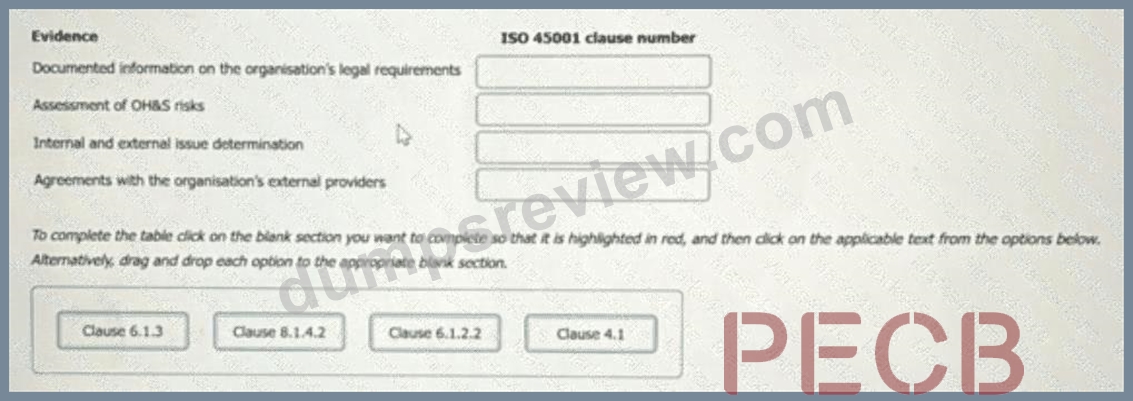
Answer:
Explanation: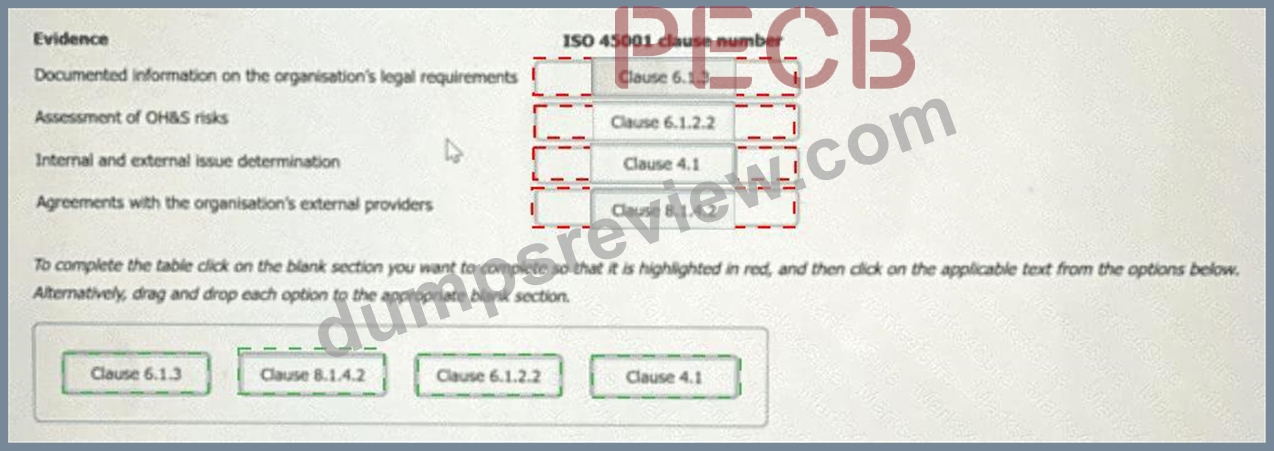
Explanation:
A screenshot of a computer Description automatically generated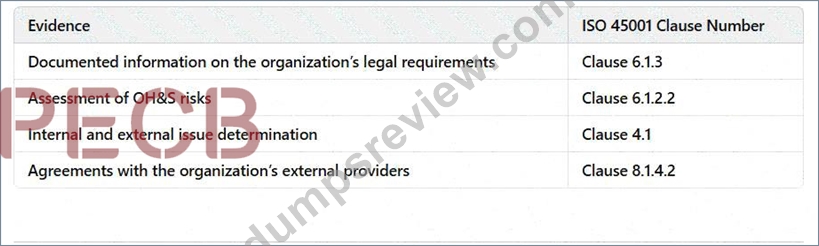
Explanation:
* Documented information on the organization's legal requirements # Clause 6.1.3:Clause 6.1.3 requires the organization to identify, document, and maintain compliance obligations, including legal and other requirements relevant to OH&S.
* Assessment of OH&S risks # Clause 6.1.2.2:Clause 6.1.2.2 mandates the organization to assess OH&S risks associated with its operations, taking into account hazards, controls, and work activities.
* Internal and external issue determination # Clause 4.1:Clause 4.1 requires organizations to determine internal and external issues that affect the OH&S management system and its intended outcomes.
* Agreements with the organization's external providers # Clause 8.1.4.2:Clause 8.1.4.2 pertains to controlling external providers and ensuring their processes align with OH&S requirements, including documented agreements.
References
* Clause 4.1: Understanding the organization and its context.
* Clause 6.1.2.2: Assessment of risks and opportunities related to OH&S.
* Clause 6.1.3: Compliance obligations.
* Clause 8.1.4.2: Control of external providers.
NEW QUESTION # 52
What is the definition of the term 'audit' as per clause 3.32 of ISO 45001:2018?
- A. A document that outlines safety procedures and guidelines
- B. A systematic process to assess the risks in a workplace
- C. A legal requirement to comply with health and safety standards
- D. An evaluation of the effectiveness of health and safety measures
Answer: D
Explanation:
According to Clause 3.32 of ISO 45001:2018, an audit is defined as a systematic, independent, and documented process for obtaining objective evidence and evaluating it to determine the extent to which audit criteria are fulfilled.
This involves assessing the effectiveness of health and safety measures implemented in the organization's OH&S management system.
Analysis of Options:
* A. A systematic process to assess the risks in a workplace:Incorrect. While audits may include risk assessments, the purpose is broader and involves evaluating the entire OH&S management system.
* B. An evaluation of the effectiveness of health and safety measures:Correct. This aligns with the definition of an audit as per ISO 45001:2018.
* C. A legal requirement to comply with health and safety standards:Incorrect. An audit is not necessarily a legal requirement but a process to assess conformity.
* D. A document that outlines safety procedures and guidelines:Incorrect. An audit is a process, not a document.
ISO Reference:
* Clause 3.32: Audit definition.
NEW QUESTION # 53
What does ISO 45001 say are the hazards that have to be considered when planning a health and safety management system? Select the ONE best answer.
- A. Work hazards and environmental factors such as bad weather
- B. Work activities where there is the possibility of danger
- C. Hot-work, working at height, enclosed space entry, and work on electrical equipment
- D. Work activities, workplace design, and human factors such as hours of work and bullying and harassment
Answer: D
Explanation:
ISO 45001:2018 requires a holistic approach to occupational health and safety. This means considering all aspects that could impact worker well-being, not just obvious physical hazards. The correct answer encompasses work activities (the tasks themselves), workplace design (the physical environment), and human factors (psychological and social aspects like working hours and harassment). It's the most comprehensive and aligned with the standard's philosophy ISO 45001:2018, Clause 6.1.2, outlines requirements for hazard identification. Hazards to consider include work activities, workplace design, human factors, and social factors that may impact OH&S. These go beyond traditional physical risks and include psychosocial and organizational hazards.
Analysis of Options:
* A. Work activities, workplace design, and human factors such as hours of work and bullying and harassment:Correct. This comprehensively addresses hazard categories outlined in ISO 45001, Clause
6.1.2.
* B. Work activities where there is the possibility of danger:Too general. ISO 45001 includes broader categories of hazards, including those related to organizational and social factors.
* C. Hot-work, working at height, enclosed space entry, and work on electrical equipment:Too narrow. These are specific hazards but do not encompass the full range outlined in ISO 45001.
* D. Work hazards and environmental factors such as bad weather:Incomplete. While environmental factors are relevant, ISO 45001 also includes workplace design, human factors, and psychosocial hazards.
ISO References:
* Clause 6.1.2.1: Hazard identification.
* Annex A.6.1.2: Examples of hazard categories, including workplace design and human factors.
NEW QUESTION # 54
Showitoff is an organization specialization in the design and production of wall decorating materials for the domestic market.
During an ISO 45001 certification audit of the site, the auditor comes across an open, walled area just outside the maintenance department. It contains various scraps of wood and metal as well as serveral rusty components. Several heavy concrete beams are learning against a thin brick wall in which cracks are available. When asked about it, the OHS Manager states that he presumes that the materials come from maintenance work, so it is the Maintenance Manager's responsibility.
The auditor interview the Maintenance Manager in his department. He asks about the area outside and is told that it contains some excess material that the Manager likes to keep in case they come in handy at some stage.
The auditor points out that the wall appears to be unstable and could collapse at any moment. The Maintenance Manager is not aware of such a situation.
The auditor decides to review the process for evaluation of compliance with health and safety regulations in more depth.
Select six option that provide a meaningful audit trail for this process.
- A. What knowledge does the OHS Manager have in relevant safety leaislation?
- B. What are the qualifications of the OHS Manager and Maintenance Managers?
- C. How arc OH&S objectives verified?
- D. How are OHSMS records of compliance evaluations controlled and managed?
- E. How arc maintenance start made aware of regulatory requirements?
- F. What is the cost of repairing the wall?
- G. How ore updates to OH&S regulations monitored?
- H. What hazards have been identified as being associated with regulations?
- I. What input does the Maintenance Manager have in the determination of legal compliance?
- J. How is the cost of safety Improvements calculated?
Answer: A,D,E,G,H,I
Explanation:
Comprehensive Detailed Explanation along with All ISO 45001 Audit References An audit trail for evaluating compliance with regulations should focus on the identification, communication, and monitoring of legal and other requirements. Clause 9.1.2 of ISO 45001:2018 requires organizations to evaluate compliance with applicable OH&S legal and other requirements.
Analysis of Options:
* A. What is the cost of repairing the wall?Irrelevant to compliance evaluation, as cost considerations are not part of legal compliance.
* B. What hazards have been identified as being associated with regulations?Correct. Identifying hazards is a critical step in understanding compliance obligations (Clause 6.1.2).
* C. How are maintenance staff made aware of regulatory requirements?Correct. Communication and training are vital for compliance (Clause 7.3).
* D. How are OH&S objectives verified?Not directly relevant to compliance evaluations, as objectives pertain to performance improvement.
* E. How are OHSMS records of compliance evaluations controlled and managed?Correct. Proper documentation and record-keeping are essential for demonstrating compliance (Clause 7.5).
* F. How are updates to OH&S regulations monitored?Correct. Monitoring regulatory changes is critical for maintaining compliance (Clause 6.1.3).
* G. How is the cost of safety improvements calculated?Irrelevant to compliance, as cost analysis is not required by ISO 45001.
* H. What are the qualifications of the OHS Manager and Maintenance Manager?While competence is important, this does not directly relate to compliance evaluations.
* I. What input does the Maintenance Manager have in the determination of legal compliance?
Correct. Understanding the roles and responsibilities of key personnel ensures effective compliance (Clause 5.3).
* J. What knowledge does the OHS Manager have in relevant safety legislation?Correct. Awareness of applicable legislation is critical for effective compliance evaluation (Clause 7.2).
ISO References:
* Clause 9.1.2: Evaluation of compliance.
* Clause 6.1.2: Hazard identification and risk assessment.
* Clause 7.5: Documented information.
NEW QUESTION # 55
An audit team leader prepares the audit plan for an initial Stage 2 certification audit. Which two of the following statements are false?
- A. The audit team leader does not select the OHS audit team members.
- B. The organisation should review the audit plan for agreement.
- C. The plan does not need to include the names of the senior managers.
- D. The organisation should cancel at staff leave during the audit.
- E. The audit team leader should present the plan to the auditee before the Stage 2 audit.
- F. The audit team leader should plan to interview each employee.
Answer: A,F
Explanation:
Comprehensive Detailed Explanation along with All ISO 45001 Audit Reference Analysis of Each Option:
A . The organisation should review the audit plan for agreement.
True.
According to ISO 45001 guidelines and ISO 19011 (Guidelines for Auditing Management Systems), it is standard practice for the auditee organization to review and agree to the audit plan to ensure clarity on scope, objectives, and processes.
Reference: ISO 19011:2018, Clause 6.3.2.
B . The audit team leader does not select the OHS audit team members.
False.
The audit team leader is responsible for selecting competent team members with the requisite expertise to evaluate the auditee's Occupational Health & Safety Management System (OHSMS). Selection is based on criteria such as knowledge of ISO 45001, auditing skills, and understanding of the industry.
Reference: ISO 19011:2018, Clause 5.4.2 and 6.3.1.
C . The audit team leader should plan to interview each employee.
False.
While employee interviews are an essential part of gathering evidence during an ISO 45001 audit, interviewing every employee is impractical and unnecessary. A representative sampling strategy is used to assess compliance across various levels and departments.
Reference: ISO 19011:2018, Clause 6.4.6.
D . The audit team leader should present the plan to the auditee before the Stage 2 audit.
True.
Presenting the audit plan to the auditee before the audit is essential to ensure all parties are informed and prepared for the audit. This practice is emphasized in ISO 19011 and supports transparency and effective audit execution.
Reference: ISO 19011:2018, Clause 6.3.3.
E . The organisation should cancel staff leave during the audit.
False.
ISO 45001 and related audit guidelines do not mandate the cancellation of staff leave during audits. While key personnel should be available, the audit team collaborates with the organization to plan around leave schedules to minimize disruption.
Reference: Not explicitly covered in ISO 45001 or ISO 19011; falls under planning discretion.
F . The plan does not need to include the names of the senior managers.
True.
While the audit plan should outline the scope, objectives, and methods, it does not specifically require the inclusion of senior managers' names unless they are directly involved in the audit.
Reference: ISO 19011:2018, Clause 6.3.2.
Key ISO Reference:
ISO 45001:2018, Clause 9.2 (Internal Audit Requirements).
ISO 19011:2018, Clauses 5.4.2, 6.3.1, 6.3.2, and 6.4.6.
NEW QUESTION # 56
On behalf of a certification body, you are conducting a combined audit of Shelf-Fit. The organization designs, manufacturing install interiors for retail stores. They employ subcontractors for the installation work.
Representing the ISO 45001 audit, you ask the Purchase Manager about the identification of health and safety hazards for contractors on site. Having previously reviewed the hazards list (HZD-21/11 Rev.3), you found that various health and safety hazards were listed but not were associated with contractor working on-site.
When you ask about the use of contractors, the response is, ''We know that contractors use chemicals, such as glues, paints and vanishes. We trust them since they know more than we do about the safe handling of such issues''. The auditor made the same enquiry to an accompanying member of the health and safety team and was told that chemical safety had never been a problem with the installation process.
- A. No hazard assessment by Shelf-Fit were in place for installation works on customer sites. (Clause 6.1.2.2)
- B. The organization did not have a documented process in place to control outsourced work. (8.1.4.3)
- C. There was not communication between the organization and site contractors (7.4.1.c.2)
- D. The purchase manager confirmed that the safe use of chemicals in installation work was left to the contractor
- E. After gathering more evidence, you note down findings against several clauses of ISO 45001. Select three options to determine which findings stated are major nonconformities.
- F. The organization failed to include its OH&S policy in contracts for installation contractors (5.2.f)
- G. The internal audit programme does not include installation sites. The audit programme does not cover the full OHS management system (Clause 9.2.2)
- H. Staff indicated that chemical hazards on installation sites are the same as at the factory. The hazard List does not reference this. (Clause 6.1.2.2)
- I. Some safety data sheets for chemical used were missing for some of the installation contractors.(clause 8.1.4.2)
Answer: B,C,H
Explanation:
Major nonconformities are raised when there is a systemic failure to meet ISO 45001 requirements that could lead to significant risks.
Analysis of Options:
B . Lack of a documented process for controlling outsourced work (8.1.4.3):
Major nonconformity. A failure to control outsourced work is a serious systemic issue.
C . Failure to include OH&S policy in contractor contracts (5.2.f):
Not a major nonconformity. While this is a nonconformity, it is procedural and not critical.
D . No hazard assessment for installation works (6.1.2.2):
Major nonconformity. A lack of hazard assessment for site-specific tasks is a serious issue.
E . Missing safety data sheets for contractor chemicals (8.1.4.2):
Not a major nonconformity. While important, this issue does not indicate systemic failure.
G . Chemical hazards on installation sites not referenced in the hazard list (6.1.2.2):
Major nonconformity. This reflects a failure in hazard identification and risk assessment.
H . Internal audit program does not cover installation sites (9.2.2):
Not a major nonconformity. This is a gap in auditing scope but does not directly endanger safety.
I . Safe use of chemicals left to contractors:
Not a major nonconformity. This could be addressed through improved contractor oversight rather than indicating systemic failure.
ISO Reference:
Clause 8.1.4.3: Control of outsourced processes.
Clause 6.1.2.2: Hazard identification and risk assessment.
Clause 7.4.1: Communication requirements.
NEW QUESTION # 57
You are in the closing meeting of a second-party audit to ISO 45001. Which three of the following topics are most likely to come for discussion?
- A. The names and email address of a attendees at the closing meeting. The question of who should chair the closing meeting.
- B. Whether the audit has correctly performed in current contracts with other customers.
- C. The extent to which the auditee Is conforming to the requirements set out in ISO 45001.
- D. The extent to which the auditee is conforming to the OH&S requirements contained in supply contracts with the auditing organisation.
- E. Whether the work instructions for a specify auditee OH&S process are focused on efficiency.
- F. nature of the trading relationship that currently exists between the auditee's and auditor's organisations.
- G. The extent of the auditee's documented information system.
Answer: C,D,F
Explanation:
The closing meeting of a second-party audit focuses on the findings, conformance to agreed requirements, and areas for improvement. ISO 19011:2018 provides guidance on closing meetings, stating that the results of the audit, including conformity with criteria, must be reviewed and agreed upon.
Analysis of Options:
* A. The names and email addresses of attendees at the closing meeting:Irrelevant. Attendance details are not part of the audit discussion.
* B. The extent of the auditee's documented information system:While relevant during the audit, it is not typically a focus in the closing meeting.
* C. The extent to which the auditee is conforming to OH&S requirements in supply contracts:
Correct. Second-party audits often assess compliance with contractual requirements.
* D. The extent to which the auditee conforms to ISO 45001 requirements:Correct. The core purpose of the audit is to evaluate conformity to ISO 45001.
* E. The nature of the trading relationship between the organizations:Correct. The trading relationship often shapes the scope and context of second-party audits.
* F. Whether the audit has correctly performed in current contracts with other customers:
Irrelevant. The focus is on the specific audit, not contracts with other customers.
* G. Whether the work instructions for a specific OH&S process are focused on efficiency:
Irrelevant. Efficiency is not the primary focus of an OH&S audit.
ISO References:
* ISO 19011:2018, Clause 6.6.1: Conducting the closing meeting.
* ISO 45001:2018, Clause 9.2: Internal audit requirements.
NEW QUESTION # 58
Match the correct responsibility with each participant of a second-party audit: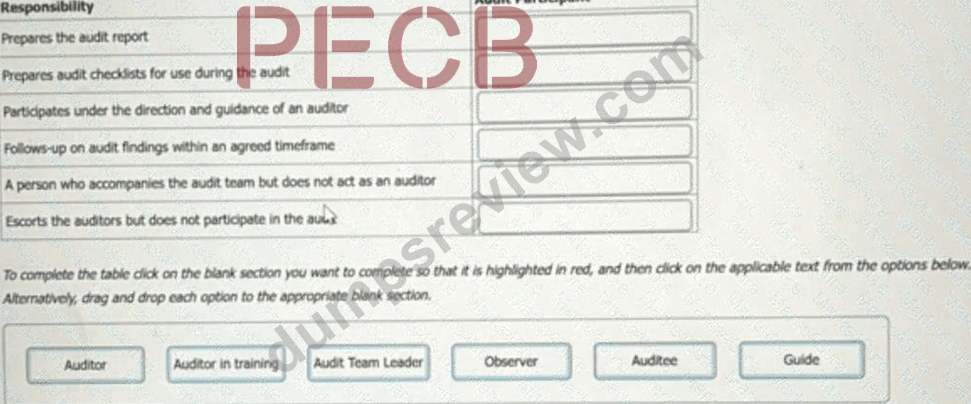
Answer:
Explanation: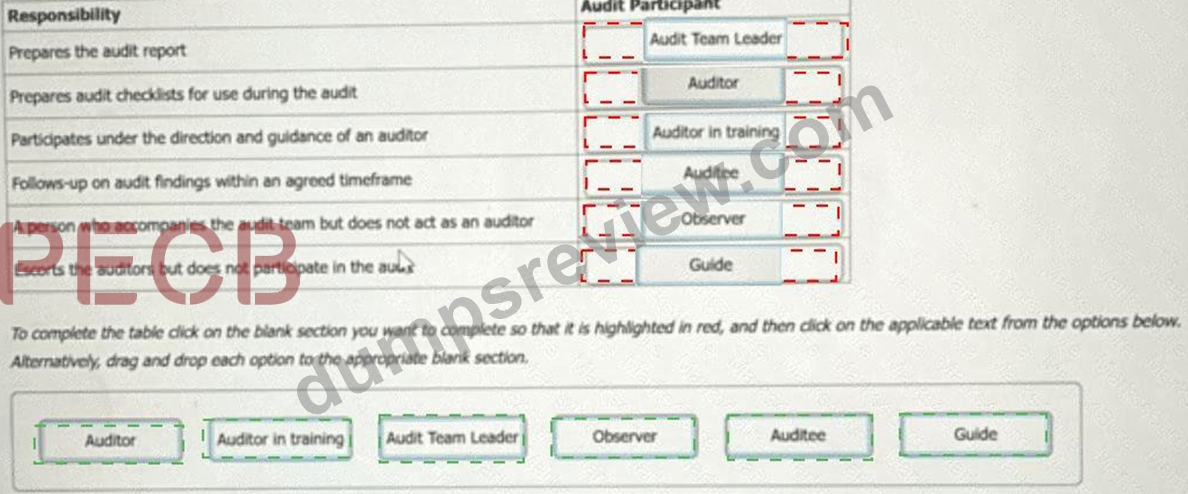
Explanation:
A screenshot of a computer Description automatically generated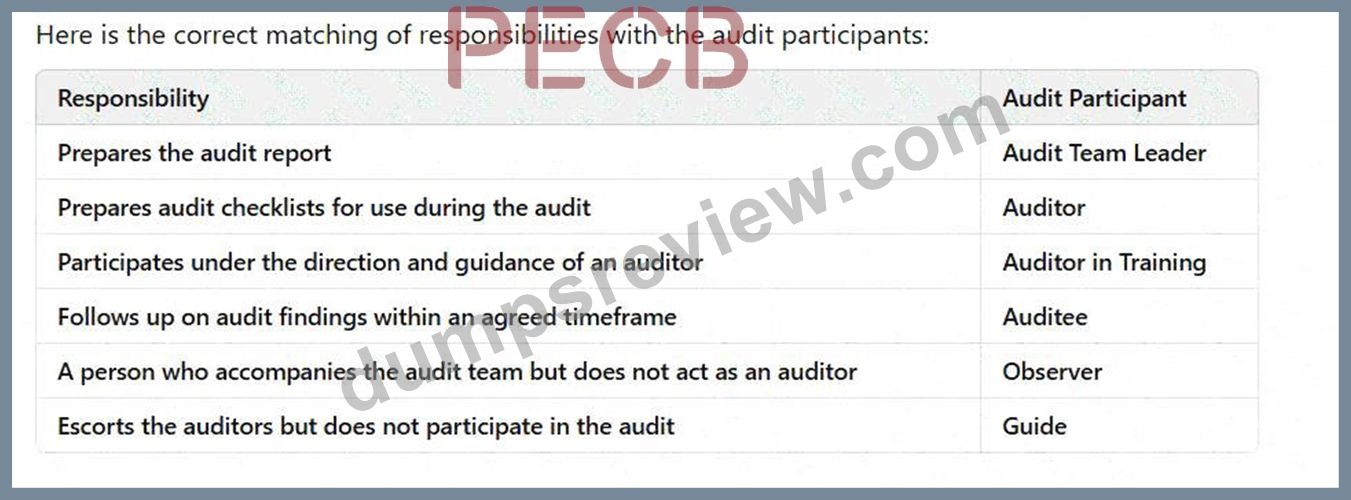
Explanation:
* Prepares the audit report # Audit Team Leader:The Audit Team Leader is responsible for compiling and preparing the final audit report, summarizing findings and conclusions.
* Prepares audit checklists for use during the audit # Auditor:Auditors create checklists to ensure a thorough and systematic evaluation during the audit.
* Participates under the direction and guidance of an auditor # Auditor in Training:An auditor in training works under supervision to gain experience and contribute to the audit process.
* Follows up on audit findings within an agreed timeframe # Auditee:The auditee is responsible for addressing and resolving audit findings and providing evidence of corrective actions.
* A person who accompanies the audit team but does not act as an auditor # Observer:Observers are typically external parties or internal personnel who watch the audit process but do not participate actively.
* Escorts the auditors but does not participate in the audit # Guide:A guide facilitates the audit by helping auditors navigate the site and access relevant areas or documents.
References
* ISO 19011:2018: Guidelines for auditing management systems.
NEW QUESTION # 59
Whistlekleen is a national dry cleaning and laundry organization with 50 shops. You are conducting an OHSMS surveillance audit of the head office and are sampling health and safety performance monitoring. You find that 80 per cent of incident originate from five shops in the same region. Most of these relate to staff and customer feeling unwell due to breathing in the pungent atmosphere. Some required to be hospitalized. The OHS Manager tells you that these are the oldest shops in the organization. The cleaning equipment emits Volatile Organic Compounds (VOCs) and needs replacing but the organisation cannot afford it at the moment.
You raise the following nonconformity against clause 10.2 of ISO 45001.
''The organization failed to act after incidents in the five old shops involving the release of VOCs from laundry operations, which resulted in injury in some instances. The equipment used was not capable of consistently operating to the required level of safety'' Select one of the options which would constitute the most effective corrective action for the nonconformity.
- A. Reassess the OH&S risks associated with the laundry process in the five old shops.
- B. Evaluate and update the Personal protective equipment (PPE) requirements for employees working with strong chemicals such as face masks and gloves.
- C. Display on emergency phone number in a prominent place to ensure that injured workers and shoppers
- D. Review the current safety procedures related to handling and use of chemicals In the laundry process to ensure their effectiveness.
Answer: A
Explanation:
Comprehensive Detailed Explanation along with All ISO 45001 Audit Reference Clause 10.2 of ISO 45001 pertains to Nonconformity and Corrective Action. Organizations are required to evaluate incidents, investigate their causes, and implement effective corrective actions to prevent recurrence.
Issue Identified:
The incidents in the five old shops are related to VOC emissions from outdated equipment, leading to staff and customer health concerns. This indicates inadequate risk management and failure to act on known safety issues.
Analysis of Options:
A . Display an emergency phone number.
This is a reactive approach and does not address the root cause of the issue, i.e., VOC emissions. It also does not align with ISO 45001's emphasis on preventive measures.
B . Evaluate and update the PPE requirements.
While PPE is important, relying solely on PPE without addressing the root cause (emission of VOCs) is insufficient. PPE is considered the last line of defense under the hierarchy of controls.
C . Reassess the OH&S risks associated with the laundry process in the five old shops.
This option aligns with ISO 45001, Clause 8.1.2, and Clause 10.2, as it emphasizes reassessing risks and taking steps to mitigate them. A thorough risk assessment could lead to interim measures such as process improvements or administrative controls until the equipment is replaced.
D . Review the current safety procedures.
While reviewing safety procedures is useful, it does not address the specific nonconformity related to the equipment's inability to operate safely.
Best Action:
Reassessing the risks in the five shops (Option C) ensures a comprehensive review of the hazards posed by outdated equipment, leading to appropriate preventive and corrective actions.
ISO Reference:
Clause 10.2: Requires identifying and addressing nonconformities to prevent recurrence.
Clause 8.1.2: Emphasizes the hierarchy of controls and risk assessment as a foundation for mitigating hazards.
NEW QUESTION # 60
An audit team leader arrives at a steel fabrication organisation that manufactures stairways to carry out a Stage2 certification audit. At a meeting with the OHSMS Manager, she is told that they have won their biggest contact from a construction organization to manufacture and install stairways.
During the audit, a team member found that several employees had suffered hand injuries over several months due to handrail welds not being property polished. The OHSMS Manager blames the new employees they had to take on because of the big contract. The auditor raises a nonconformance against clause 10.2 erf ISO 45001.
In relation to the nonconformity raised by the auditor and in line with the policy of the certification body, the audit team raise improvement opportunities in the audit report.
Which three of the options would represent acceptance opportunities for improvement in the report?
- A. A first aid station could be located next to the handrail polishing operation.
- B. All workers should be given competence test.
- C. A quality control programme could involve non-destructive testing of the welded handrails
- D. The requirement for wearing protective gloves could be extended to shop floor workers across all operations.
- E. The induction programme for new employees could include an awareness training video in health and safety.
- F. Operational planning activities may benefit from an improved risk based approach based on international standards tor risk management.
- G. Additional internal audits of the OHS management system may reduce production problems.
- H. The molding polishers should be disciplined for Incompetency.
Answer: D,E,F
Explanation:
Comprehensive Detailed Explanation along with All ISO 45001 Audit Reference Opportunities for improvement (OFIs) are suggestions provided during audits that do not indicate nonconformities but are aimed at enhancing the system's performance.
Analysis of Options:
A . A quality control program could involve non-destructive testing of the welded handrails:
While beneficial, this focuses on product quality rather than OH&S improvements.
B . Operational planning activities may benefit from an improved risk-based approach based on international standards for risk management:
Correct. Enhancing risk-based thinking aligns with Clause 6.1.1.
C . A first aid station could be located next to the handrail polishing operation:
While useful, first aid station placement is an operational matter, not directly related to OH&S management system improvement.
D . Additional internal audits of the OHS management system may reduce production problems:
Internal audits should address system performance, not production problems.
F . The induction program for new employees could include an awareness training video on health and safety:
Correct. Enhanced training for new employees addresses Clause 7.2 (competence).
G . The requirement for wearing protective gloves could be extended to shop floor workers across all operations:
Correct. This improves hazard control in line with Clause 8.1.2.
H . The molding polishers should be disciplined for incompetency:
Disciplinary actions are outside the scope of system improvement.
ISO Reference:
Clause 6.1.1: Risk management.
Clause 7.2: Competence.
Clause 8.1.2: Hierarchy of controls.
NEW QUESTION # 61
What is the definition of the term 'audit' as per clause 3.32 of ISO 45001:2018?
- A. A document that outlines safety procedures and guidelines
- B. A systematic process to assess the risks in a workplace
- C. A legal requirement to comply with health and safety standards
- D. An evaluation of the effectiveness of health and safety measures
Answer: D
Explanation:
According to Clause 3.32 of ISO 45001:2018, an audit is defined as a systematic, independent, and documented process for obtaining objective evidence and evaluating it to determine the extent to which audit criteria are fulfilled.
This involves assessing the effectiveness of health and safety measures implemented in the organization's OH&S management system.
Analysis of Options:
A . A systematic process to assess the risks in a workplace:
Incorrect. While audits may include risk assessments, the purpose is broader and involves evaluating the entire OH&S management system.
B . An evaluation of the effectiveness of health and safety measures:
Correct. This aligns with the definition of an audit as per ISO 45001:2018.
C . A legal requirement to comply with health and safety standards:
Incorrect. An audit is not necessarily a legal requirement but a process to assess conformity.
D . A document that outlines safety procedures and guidelines:
Incorrect. An audit is a process, not a document.
ISO Reference:
Clause 3.32: Audit definition.
NEW QUESTION # 62
Wokrer's participations is a key factor for the success of OHSMS. Which three of the following ISO 45001 activities require workers' participation?
- A. Establishing OHS objectives
- B. Managing internal audit programme
- C. Determining what needs to be communciated
- D. Determining competence requirements
- E. Establishing OHS policy
- F. Determining actions to eliminate hazards
Answer: A,E,F
Explanation:
Worker participation is a fundamental principle of ISO 45001 (Clause 5.4). It ensures workers at all levels are involved in key activities to enhance the OH&S management system's effectiveness.
Analysis of Options:
* A. Determining competence requirements:Incorrect. Determining competence is primarily the responsibility of management, though workers may provide input.
* B. Establishing OHS objectives:Correct. Worker involvement ensures objectives are realistic and relevant to workplace conditions (Clause 6.2).
* C. Managing internal audit programme:Incorrect. Managing audits is typically a managerial responsibility, though workers may participate in audits.
* D. Determining actions to eliminate hazards:Correct. Workers' insights are critical in identifying and implementing actions to eliminate hazards (Clause 8.1.2).
* E. Determining what needs to be communicated:Incorrect. While communication strategies impact workers, their participation in determining communication needs is not explicitly required.
* F. Establishing OHS policy:Correct. Workers should be involved in developing policies to ensure relevance and buy-in (Clause 5.2).
ISO References:
* Clause 5.4: Worker participation.
* Clause 6.2: OHS objectives.
* Clause 8.1.2: Hierarchy of controls and hazard elimination.
NEW QUESTION # 63
......
ISO-45001-Lead-Auditor Certification All-in-One Exam Guide Apr-2026: https://quizmaterials.dumpsreview.com/ISO-45001-Lead-Auditor-exam-dumps-review.html
